The dark role of archeology in the battle for Hebron’s Tel Rumeida
HEBRON – “As you can see we live in a cage,” Arwa Abu Haikel sighed
as she walked up the steps of her home. “Because of the continuous
attacks by settlers, throwing stones, breaking windows and causing
injuries, we had to build the bars around the windows.” Based in Tel
Rumedia, a neighborhood of Hebron, Arwa’s home possesses one of the most
contentious postcodes of the occupied Palestinian territory.
Hebron has been the epicenter
of burgeoning violence since the outbreak of the so-called “Third
Intifada” at the beginning of October, and a few weeks ago the Israeli
military
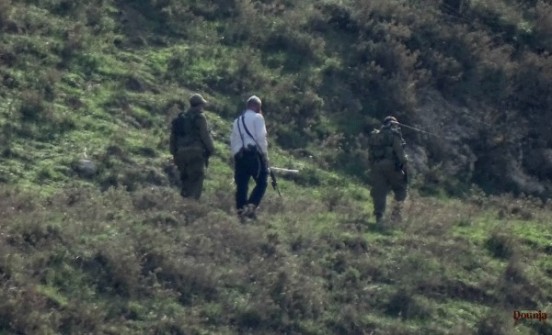
declared the whole of Tel Rumeida a closed military zone.
Despite this, Palestinian residents told
Ma’an that Tel
Rumedia’s difficulties long precede the recent spate of violence, and
can be seen in the fight over the area’s archaeological ruins.
The troubled neighborhood has been at the heart of a longstanding
battle — between settlers in the area, numerous rights groups and the
Palestinian municipality of Hebron — over the development and management
of an archaeological site that’s thousands of years old.
Critics say that the site is being used by a state-funded body for
the benefit of extremist Israeli settlers living in the area, who have
been aiming for decades to push local Palestinians out of their homes
and out of the neighborhood.
A front for settler expansion
Based on archaeological surveys, the Tel Rumeida archaeological site
dates back to the formation of Hebron in the middle Bronze Age. The site
also has remains originating in the Hellenistic, Roman and Byzantine
periods. Excavations by the Israeli Antiquities Authority (IAA) began in
1967, but last year new excavations started in what many criticize as a
political move taken to support the presence of settlers in the area.
Yonathan Mizrachi is an Israeli archaeologist who used to work for the
IAA, but left the body in order to establish
Emek Shevah,
an organization which monitors the role of archaeology in the
Israeli-Palestinian conflict. Yonathan says the importance of and
contention over the site in Tel Rumeida come from the possible
implication it has for the demographic balance of the area. “In 2014 the
IAA began a new excavation in Tel Rumeida on behalf of the settlers in
order to make the site an archaeological park,” Yonathan told
Ma’an.
“When we started to monitor activity in Tel Rumeida, we began to see
different ways that archaeology is used as a political tool,” he said.
“First of all, the idea of developing an archaeological park is the
best way — from the settlers’ point of view — of how they can take over
the land. They also realize that it can increase their power and their
legitimacy over this place,” Mizrachi added.
The IAA — supported and sponsored by the Israeli government —
received 7 million shekels ($1.8 million) last year from Israel’s
Ministry of Culture and Sport for the Tel Rumeida project, according to
Mizrachi.
Abu Haikel told
Ma’an that her family owns segments of land
in Tel Rumeida, parts of which have been confiscated by the Israeli
military and are threatened by the expansion of the archaeological park.
“Our daily life is difficult. To live in Tel Rumeida you have to be
very strong, very patient and very peaceful,” Arwa said. She spoke of
her fear from increasing numbers of settlers in the area, and the
problem that a large influx of tourists to a settler-run archaeological
park may pose for Palestinian residents. “Through the years, we have
been attacked many times by settlers, especially by buses of Zionist
extremist tour groups. They cause a lot of trouble for us and have
physically assaulted us many times… I have a problem in the nerve of my
eye from being attacked by a settler,” Abu Haikal explained to
Ma’an.
The manipulation of history
Dr. Ahmed Rjoub is the director of the Department of Site Management
at the Palestinian Authority Ministry of Tourism and Antiquities. When
speaking to
Ma’an about his concerns over the management of Tel
Rumeida, Rjoub explained that “the conflict is all on history, and as
such Tel Rumeida is a conflicted place, not just in terms of the
physical space but a conflict over history and culture, heritage and
identity.
“We have a lot of fears that the history, the archaeology and the
remains of this site will be faked for the interests of Israeli
heritage,” Rjoub told
Ma’an.
Rjoub had grave concerns over the conservation of the site,
especially regarding any artifacts that might be related to Islamic
heritage. “They actually found some tombs and ruins relating to the
Roman and Islamic period and removed them,” he claimed. Rjoub said that
such excavations — their methods in particular — violate standards put
in place by both Palestinian and international law, and are “against the
ethics of archaeology.
“Such excavations, especially the methods of excavations, violate the
international standards of Palestinian and international law, and are
against the ethics of archaeology.”
“As members of the PA we tried to interfere,” Rjoub told
Ma’an.
“In Oslo there is an article saying any project in Area C should be
coordinated with the PA. But unfortunately Israel violates even the Oslo
Accords, and refused our official requests to visit even as technical
and professional archaeologists,” Rjoub said.
Explaining how the political motivations behind the excavations go
against the grain of archaeological convention, Rjoub said: “They have
preconceptions and interpretations over this site before they have even
started the excavations.
“This is very wrong, and it isn’t a scientific method to interpret the remains before you’ve even finished excavating.”
Mizrachi also raised misgivings over the integrity of Israeli archaeological practice in the occupied Palestinian territory.
“We [Emek Shevah] are monitoring all kinds of activities of the
Israelis in the West Bank,” Mizrachi said. “Based on previous and
present cases that we know about, we have a lot of criticism in regards
to which periods are being emphasized and narrated to the people.”
Mizrachi told
Ma’an that there are those who attempt to
identify the layers of ruins with a “specific culture of today,”
labeling the area as a “Jewish site” or a “Muslim site.”
“In this land you might find an ancient synagogue, church or mosque,
obviously it is very dear to a specific culture, but it doesn’t mean
that you can claim sovereignty over it. It means that it is part of the
heritage of a place and you should protect it according to the
international convention,” Mizrachi said.
Court verdict
After lobbying efforts — carried out by the Palestinian municipality,
Tel Rumeida residents, Emek Shevah and Israeli rights group Breaking
the Silence — the Israeli Civil Administration in the West Bank agreed
to cancel the lease of the site to an pro-settlement organization,
Association for Renewed Jewish Settlement in Hebron, a few weeks ago.
However, this does not signal that the struggle in Tel Rumeida, or for
archaeology throughout the occupied Palestinian territory, is over.
Rjoub spoke of a move to raise the issue with UNESCO due to the
universal value of the site. “The international community has a
responsibility to protect this site as part of everyone’s history”, he
said.“It’s not just Palestinian cultural heritage either — this heritage
is for all,” Rjoub added.
Seeing as archaeology does not conform to contemporary political
borders — such as Israel’s separation wall, the Green Line, or the West
Bank’s delineation of Areas A, B and C — conforming excavations to a
framework of military occupation has rendered the practice problematic.
There is little structure in place to enforce accountability regarding
archaeological conduct, and other sites such as as the
City of David’s national park in occupied East Jerusalem as well as the
Tel Shilo national park
have been criticized for their current management. Israeli excavations
in occupied Palestinian land appear to systematically abuse the
occupation force’s power and flout International Law, whilst alienating
Palestinians from their cultural heritage.
Megan Hanna is a freelance photographer and journalist based in the occupied Palestinian territory.