Syrian Asylum-Seekers Are Being Forcibly Removed From The UK To Other EU Countries
As the horrors of Aleppo are laid bare, experts told BuzzFeed
News the government’s treatment of vulnerable Syrians was “inhumane and
dangerous”.
posted on Dec. 16, 2016, at 3:44 p.m.
As Mohammed was dragged on to the plane in handcuffs, he could not
understand how the other passengers were ignoring what was happening. “I
was screaming,” the 26-year old Syrian asylum-seeker said. “Four people
dragged me and forced me on to the plane. One of the guards was a woman
– she was pulling so hard on the handcuffs it cut right through my
skin. It felt like they were taking me to my death.”
Mohammed
was being forcibly removed from the UK, not because his asylum claim had
been refused but because it had never been looked into. He was being
sent back to Italy, the first European Union country he had arrived in.
He
is one of hundreds of people the UK has returned to face detention and
destitution in EU countries such as Italy and Hungary, where the
treatment of asylum-seekers has been described as “appalling”.
The
practice has led to Syrian asylum-seekers being routinely detained
while in the UK before being forcibly removed from the country against
their will. Others have gone underground and are living undocumented to
avoid removal.
Just over 4,400 Syrian refugees have been resettled
in the UK under an initiative by the government, which pledged to take
in 20,000 people by 2020.
But as people flee
Aleppo
and other besieged Syrian cities, experts are questioning how the UK
will treat those who arrive to UK shores by other means. Some described
the treatment of Syrian asylum-seekers as “inhumane and dangerous”.
Through freedom of information requests, data analysis, and interviews, BuzzFeed News has found:
- More than 700 asylum-seekers were sent back to EU countries in 2015 and the first half of 2016.
- More
than 250 of those were to Italy, a country struggling under a
near-continuous arrival of asylum-seekers. Others were flown to Hungary,
Romania, and Bulgaria.
- Forty-seven Syrians were sent back to other EU countries.
- Large numbers of Eritrean, Iraqi, and Sudanese asylum-seekers were also expelled.
The removals happened using a controversial EU-wide agreement known as the Dublin Regulation.
Under
the current system asylum-seekers are supposed to apply for asylum in
the first EU country they arrive in. But countries on the forefront of
the refugee crisis have been overwhelmed with arrivals, and so, facing a
lack of support and feeling unwelcome, many asylum-seekers choose to
keep on moving.
Nazek Ramadan, director of
Migrant Voice,
has seen scores of Syrians being threatened with return under the
system. The NGO is now preparing a report on the issue to be released
next spring.
“Those we interviewed for our recent research have
all fled warzones, and feel that after seeking safety they are living in
a different kind of warzone – going from one detention centre to
another,” Ramadan told BuzzFeed News. “They feel unprotected by the law,
pursued from all directions and cannot understand or navigate the
immigration process.
“The Dublin Regulation and its form of
implementation in the UK is inhumane and dangerous – causing
considerable suffering to people fleeing persecution, and leading to
many migrants becoming undocumented.”
Karl Pike, policy and
advocacy manager for refugees and asylum at the British Red Cross,
agreed: “The Dublin Regulation has been failing families and young
children across Europe. The priority for the UK and Europe should be
ensuring countries of first arrival are supported, with increasing
numbers of refugees and asylum-seekers transferred from those countries,
not increasing numbers transferred back to them.
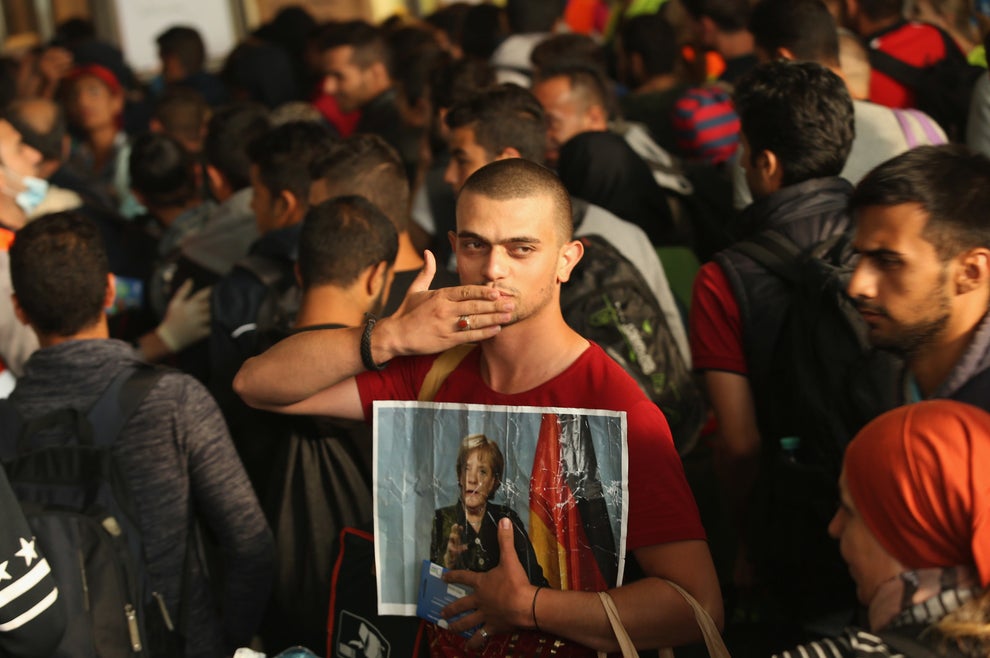
A Syrian man holds a picture of German chancellor Angela Merkel after arriving in Munich from Hungary in September last year. Sean Gallup / Getty Images
The removal policy is made possible through an EU-wide fingerprint
database that allows immigration officials to check if an asylum-seeker
has been registered in another country.
Desperate to avoid
detection, some asylum-seekers have taken to travelling via dangerous
routes, or even burning off their fingerprints.
Mohammed – who spoke to BuzzFeed News on condition his real name not be used – had never heard of these rules.
He
left Syria in 2013, when the war encroached on his city, Daraa. He
travelled first to Lebanon and then on to Italy. There, he says, he was
beaten by the police. “We were detained in Italy for 10 days,” he
remembers. “They beat me and forced me to give my fingerprints, and then
said, ‘OK, you can go where you want.”
A recent
report
from Amnesty International noted “consistent accounts of coercive
methods used by the Italian police to obtain fingerprints, including
allegations of beatings, electric shocks and sexual humiliation”.
After leaving Italy, Mohammed headed for the UK via Calais. He has cousins in Britain and was keen to reunite with family.
He
lived for more than two years just outside London, but when Mohammed
applied for asylum he was told his fingerprints had been found on the
database and he would be removed. He was held in detention centres on
two occasions, at one point living in solitary confinement for a week.
Then
last year he was put on the plane at Gatwick and flown to Venice. But
when he arrived he was told he was not wanted in Italy either. “They
said ‘the UK should be taking you’ and that I wasn’t allowed to stay in
Italy,” Mohammed said. “They gave me a document saying I’m not allowed
to stay in Italy – they gave me [an] order to leave.”
Confused and
alone, he travelled back to Calais, trying to once again get to his
family in the UK. When that failed he settled in Germany, where he was
told his fingerprints on the system did not matter.
He describes
his treatment in the UK: “It wasn’t fair. I thought there was only
oppression in Syria but there is oppression in the UK too.”
As well as Italy, the UK has sent asylum-seekers to Hungary, a country described by
Amnesty International as providing “appalling treatment” to asylum-seekers and where “poisonous anti-refugee rhetoric is reaching fever pitch”.
A handful of asylum-seekers have also been returned to Bulgaria, a country that has detained asylum-seekers and
refused to let them leave.
As well as the 700 people who have been removed, the UK has also
applied to return more than 5,300 asylum-seekers of all nationalities
since the beginning of 2015.
Those transfers are often held up by lengthy legal battles, commonly funded by legal aid.
BuzzFeed
News found that while those court battles play out, Syrians being
processed under the Dublin Regulation have been held in detention
centres across the UK. Some told us they had stopped signing in with the
Home Office for fear of being detained and removed, leaving them living
illegally and undocumented.
Ramy is 31 and also from Daraa. He has been in the UK for almost three and a half years but is facing removal to Italy.
He
had been hoping to send for his wife and young son once in the UK, but
due to delays fighting removal he could not bring them over.
“I
was so afraid for my wife and son with the bombing,” said Ramy, who also
asked that his real name not be used. “The route is very dangerous, I
didn’t want them to risk their lives coming across on the seas. I took
the risk so I could go ahead, find a secure place, and bring them
later.”
But the threat of removal has scuppered his plans. Without refugee status here he cannot apply to bring his family over.
He
has been held in detention several times but says he is desperate not
to be sent back to Italy. “I can’t go back to Italy, there is nothing
for me there, no one,” he said. “If they sent me back I would just try
to come back here to the UK.
“I don’t think I was treated fairly at all [by the UK government].”
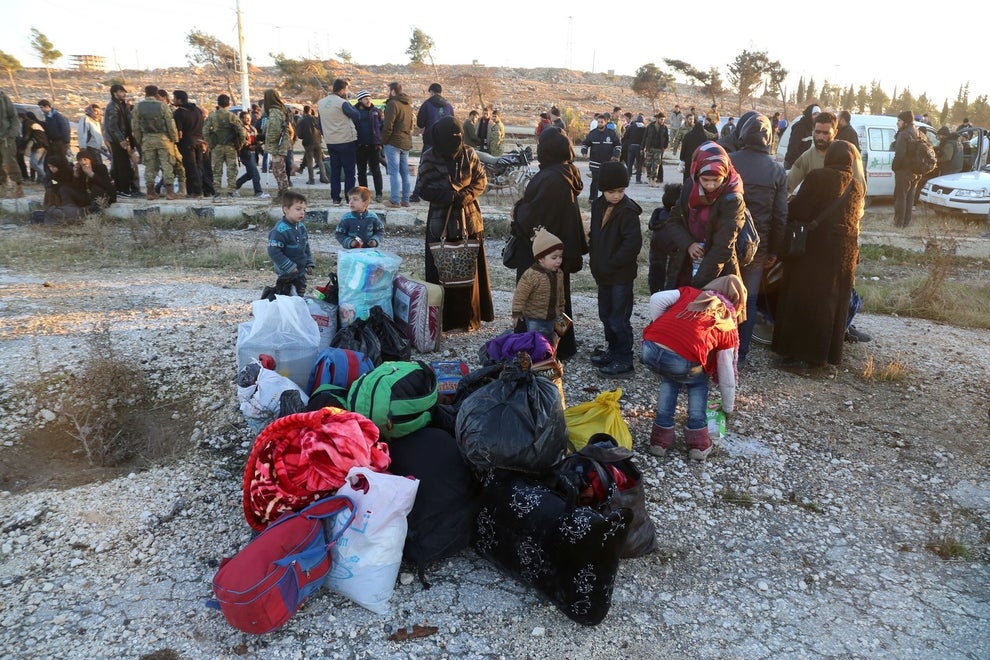
Syrians evacuated from rebel-held neighbourhoods of eastern Aleppo this week. Baraa Al-halabi / AFP / Getty Images
While the UK continues to remove people under the policy, the future of the Dublin Regulation is unclear.
A proposal for revision to the system was published in May and is being considered by the European Commission and MEPs.
It
was hoped by some that the revisions would balance out the burden of
asylum across EU countries, but the new proposals will actually make it
easier to remove people to the first country of entry.
Minos
Mouzourakis from the European Council on Refugees and Exiles said: “The
proposed changes actually makes it just as challenging for countries on
frontlines.”
The British government has been one of the voices
arguing against changes to spread the burden, but it is unclear what
will happen once the UK has left the EU.
“The main issue the UK is
facing is if it ceases being an EU member it could only participate
through an agreement like Switzerland does – where the quid pro quo is
buying into Schengen [the zone in Europe where there are no border
checks between countries] for buying into Dublin,” said Mouzourakis.
“But
if the UK refuses Schengen, then it will be very difficult for it to
participate in the Dublin system at all.” In the current political
climate, there is virtually no chance the UK will join Schengen.
Last year the UK
ranked 15th in Europe for the number of refugees it took in, relative to its size. Asylum-seekers make up around
4% of immigrants to the UK, according to independent fact-checking organisation Full Fact.
A Home Office spokesperson told BuzzFeed News the government was on track to welcome 20,000 Syrian refugees by 2020.
But
they said the asylum system, which the government’s resettlement scheme
is separate from, would only work if applications made within the EU
adhere to the principles of the Dublin Regulation.
“The UK has a
proud history of offering protection to those who need it, but we will
not shoulder the burden of asylum claims which should rightly be
considered by other countries,” the spokesperson said.
“We firmly
believe in the established principle, enshrined in the Dublin
Regulation, that those in need of protection should seek asylum in the
first safe country they enter. We will always fully consider cases
passed to us.”




 The gunman who stormed an Islamic center in central Zurich
  German police say the driver who rammed his truck into a crowded Berlin
Christmas market, killing 12 people and injuring another nearly 50
German police say the driver who rammed his truck into a crowded Berlin
Christmas market, killing 12 people and injuring another nearly 50