The
Church of England has been plunged into fresh turmoil after its general
assembly threw out a report on same-sex relationships in a rebuff to
bishops following almost three years of intense internal discussion and
intractable divisions.
The
C of E’s synod,
meeting in London this week, voted on Thursday to effectively reject
the report, which upholds traditional teaching that marriage is a
lifelong union of a man and a woman.
Although there was a
clear overall majority in favour of “taking note” of the report, it
needed the support of all three houses – bishops, clergy and laity. The
clergy narrowly voted against, by 100 votes to 93, meaning the motion
was lost.
The de facto rejection of the report is a blow to the authority of
Justin Welby,
the archbishop of Canterbury, who pleaded with the synod to accept the
report as “a basis for moving on, a good basis, a roadmap”.
Welby presides over the House of Bishops, which has met four times since
internal discussion groups wound up last July to chart the way forward between two apparently unreconcilable wings of the church.
Responding
to the vote, Graham James, bishop of Norwich, said: “I can guarantee
that the House of Bishops will consider carefully and prayerfully all
the contributions made in the debate today.”
He
added: “We have listened to those who have spoken, and those others who
have made contributions to us directly. Our ongoing discussions will be
informed by what members of synod and the wider church have said as a
result of this report.”
Acknowledging that the next steps were
unclear, Pete Broadbent, bishop of Willesden, said: “In this debate, we
haven’t even begun to find a place where we can coalesce.... More
conversation is needed. We don’t yet know the next stage – nor yet when
and whether we can bring any further report to synod.”
The issue
has dominated the current four-day session of the synod, and has been
the subject of bitter debate within the C of E – and the global Anglican
communion – for decades. At the moment,
gay clergy are forbidden from marrying or having sexual relationships, and same-sex marriage services are prohibited in churches.
In
a debate lasting more than two hours, about one in three members of the
synod requested to speak from the packed floor of the auditorium. Many
contributions included personal testimonies from lesbians and gay men.
Jayne
Ozanne of Oxford accused the bishops of putting “political expediency
ahead of principle”. Fearing a split, they had “chosen not to lead but
to manage”.
Simon Butler of Southwark, an openly gay member of
synod, said that “only when fracture comes can new possibilities
emerge”, and quoted Genesis: “I will not let you go until you bless me.”
Lucy
Gorman of York told the synod that “outside these walls, we are being
heard as lacking in love”. No wonder, she added, that fewer young people
were coming to church. “Why would people become part of a church that
is seemingly homophobic?”
But those on the conservative wing
of the church also expressed criticisms and some voted against the
report. Andrea Minichiello-Williams of Chichester said: “All sexual
expression outside a lifelong permanent union on one man and one woman
is sinful.”
Sexuality
was a “first order issue”, one on which salvation depends. “That’s why
it’s so important to speak clearly with regard to sexual sin.”
Paul
Bayes, bishop of Liverpool, said: “I honour the anger and, indeed,
fury, of the LGBTI community who see in this report hard stones when
they looked for bread.” However, he urged the synod to back the report,
saying its encouragement for clergy to exercise maximum freedom within
existing doctrine “may carry us to places we have not previously gone”.
The report, he said, “cannot, will not and should not mark the end of
the road” on the issue.
Welby, the final speaker to be called,
said “how we deal with profound disagreement… is the challenge we
face”. The church needed to be “neither careless in our theology nor
ignorant of the world around us”, he added.
Before the debate,
both James and Broadbent, who led the bishops’ group which wrote the
report, apologised to its critics. “It has not received a rapturous
reception in all quarters, and I regret any pain or anger it may have
caused. And if we’ve got the tone wrong, we are very sorry,” said James.
Broadbent
acknowledged it was “a pretty conservative document”, adding: “I do
want to apologise to those members of synod who found our report
difficult, who didn’t recognise themselves in it, who had expected more
from us than we actually delivered, for the tone of the report. On
behalf of the House [of Bishops], and without being trite or trivial,
I’m sorry.”
While upholding traditional doctrine on marriage, the
report said teaching should be interpreted with “maximum freedom” for
same-sex couples and called for a “fresh tone and culture of welcome and
support” for lesbians and gays while proposing no concrete change.
Following
the vote, Ozanne, a leading gay rights campaigner on the synod, said:
“I am thrilled that this report has been voted down. We now look forward
to working together to build a church that is broad enough to accept
the diversity of views that exist within it, courageous enough to
address the deep divisions that exist between us and loving enough to
accept each other as equal members of the body of Christ.”
Simon
Sarmiento, chairman of LGBTI Mission, said: “I’m pleased the report was
not accepted. I am sure the bishops will have learned a lesson from
this experience which I know has been painful. I hope they will now
consult widely and proceed wisely.”
Andrea Williams, from the
conservative Christian Concern, said the report had tried “to straddle
positions that cannot be reconciled”. She added: “This shouldn’t be read
as a victory for the LGBT activists within the Church. The reason why
this happened was because there was no clarity in which direction the
church will go.”
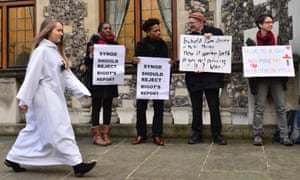
LGBTI Christians and supporters of gay equality
held a vigil outside Church House in Westminster, the venue for the
synod, during the debate.





 Acting Attorney General Sally Yates warned White House officials that
incoming National Security Adviser Michael Flynn had been dishonest
about the nature of his calls with Russia’s ambassador, The Washington
Post reports. Flynn resigned from his post
Acting Attorney General Sally Yates warned White House officials that
incoming National Security Adviser Michael Flynn had been dishonest
about the nature of his calls with Russia’s ambassador, The Washington
Post reports. Flynn resigned from his post 