Search This Blog

Friday, February 24, 2017

Listen to Controversial White House Terrorism Adviser Sebastian Gorka’s Angry Call to a Critic

Listen to Controversial White House Terrorism Adviser Sebastian Gorka’s Angry Call to a Critic

In a recording provided to Newsweek, Gorka threatened terrorism propaganda expert Michael S. Smith with legal action for criticizing him in a series of tweets.

Updated | An embattled White House terrorism advisor whose academic credentials have come under widespread fire telephoned one of his main critics at home Tuesday night and threatened legal action against him, Newsweek has learned.
Sebastian Gorka, whose views on Islam have been widely labeled extremist, called noted terrorism expert Michael S. Smith II in South Carolina and expressed dismay that Smith had been criticizing him on Twitter, according to a recording of the call provided to Newsweek.
“I was like a deer in the headlights,” Smith, a Republican who has advised congressional committees on the use of social media by the Islamic State militant group (ISIS) and al-Qaeda, tells Newsweek. “I thought it was a prank. He began by threatening me with a lawsuit.”
Gorka apparently used his personal cell phone, with a northern Virginia area code, rather than making the call from his White House office or government-issued cell phone, where it would be officially logged, Smith says. The terrorism expert says he suspected Gorka “was trying to conceal the call.”
Smith says he did not begin recording the call until after Gorka allegedly threatened to sue Smith. In an email to Newsweek, Smith said that, “Gorka asserted my tweets about him merited examination by the White House legal counsel. In effect, he was threatening to entangle me in a legal battle for voicing my concerns on Twitter that he does not possess expertise sufficient to assist the president of the United States with formulating and guiding national security policies.”
Gorka did not respond to an email requesting comment.
Smith has been a regular contributor to think tank and TV discussions on terrorism, particularly the use of social media by al-Qaeda and the Islamic State militant group. Last year Foreign Policy magazine included him in its list of “100 Leading Global Thinkers.”
Read more: The Islamophobes at the heart of Trump’s White House
Smith has kept up a steady stream of jabs at Gorka since he learned that the Hungarian born, British-educated terrorism specialist had been hired by President Donald Trump’s top adviser Steve Bannon. Both Bannon and Gorka came from the far-right Breitbart News, where Bannon was editor-in-chief and Gorka was national security editor. On his Twitter page, Gorka describes himself as “deputy assistant to the 45th president of America” and an “Irregular Warfare Strategist.”
His views on the “global jihadist movement,” as he calls it, align with a small cadre of right-wing observers who depict Islamist militants and extremists as being driven principally by passages from the Koran, rather than by government repression, or sectarian, tribal, political or economic factors.
On Tuesday, Smith tweeted that Gorka “doesn't know the enemies' ideologies well enough to combat them.” In an earlier tweet directed at Trump, Smith wrote: “You are endangering the lives of Americans by hiring fake ‘terrorism experts.’”
Gorka earned his doctorate from a Hungarian university in 2008 and “a few months later landed a faculty job at the College of International Security Affairs (CISA), a new Pentagon-funded school that was still working toward accreditation,” The Washington Post reported. According to an online biography, he is also an associate fellow at the Joint Special Operations University, at the U.S. Special Operations Command, and holds the Major General Horner Distinguished Chair of Military Theory at the Marine Corps University Foundation, which was funded by Thomas Saunders III, a major Republican Party donor and chairman of the conservative Heritage Foundation. The program’s current director, James Howcroft, also a retired Marine colonel, told Politico that Gorka only “periodically delivered lectures or served as a seminar leader.”
The White House advisor was clearly wounded by Smith’s taunts. “Why is this vitriol popping out of you, every day now?” Gorka asked Smith in his call. ”I look at your Twitter feed once or twice a day and it’s half a dozen tweets about me, and I’ve never even met you.”
“Wow,” Smith responded. “Are you defeating jihad by monitoring or trolling my Twitter feed?”
Gorka expressed puzzlement several times that he was being attacked “by someone who’s never met me.”
“I’ve never met you and I’ve never attacked you,” he said to Smith, his voice rising in frustration and anger. “And your Twitter feed is an incessant berating of my professional acumen. Put yourself in my shoes, Mr. Smith. Have you done that? How would you like it if someone you’ve never met, daily and professionally attacked you?”
“Happens all the time,” Smith responded. Generally speaking, academics and journalists laboring in the field of public policy expect to be criticized for their views.
"It's not happened to me,” Gorka said, “I can tell you. Maybe you can show me some trick on how you deal with it. This is the first time ever.”
In fact, questions about Gorka’s views and credentials to speak authoritatively on Islam and terrorism were severely criticized in lengthy feature articles in The Washington Post and Wall Street Journal in recent days. He also received a wave of unfavorable publicity in January 2016 when he was arrested for trying to pass through a TSA checkpoint at Reagan National Airport in Washington, D.C. carrying a loaded handgun. He was charged with a misdemeanor and sentenced to six months probation.
One of his most influential critics is Cindy Storer, a leading former CIA expert on the relationship between religious extremism and terrorism.
“He thinks the government and intelligence agencies don’t know anything about radicalization, but the government knows a lot and thinks he’s nuts,” Storer was quoted as saying in the Post.
Smith asked Gorka why he didn’t telephone Storer, "who called you nuts in the Washington Post,” to complain. Gorka responded that Storer’s remark wasn’t “in a Twitter feed that is being sent to people on Capitol Hill.”
Gorka’s scholarship has also come under scrutiny by Mia Bloom, an expert on “transcultural violence” at Georgia State University. “He doesn’t understand a fraction of what he pretends to know about Islam,” Bloom was quoted as saying by the Journal. Bloom has participated in TV appearances with Gorka and at a panel last year at the Defense Intelligence Agency.
Nor has Gorka—who does not speak Arabic and has never lived in a Muslim-majority nation, according to news accounts—submitted any of his articles for review in scholarly journals, says Lawrence P. Rubin, associate editor of Terrorism and Political Violence, the leading journal in that field.
“Gorka has not submitted anything to the journal in the last five or so years, according to my records and we have never used him as a reviewer,” Rubin tells Newsweek. “We would not have used him as a reviewer because he is not considered a terrorism expert by the academic or policy community.”
A government expert on Middle East radical movements, who asked not to be named for fear of being fired, tells Newsweek she was disturbed to hear Gorka suggest at a talk he gave in Israel a few years ago that he knew of a “specific person in the [Obama White House] who was deliberately misleading the government” on terrorism issues. “He said he wouldn’t name the person on stage but would provide the particulars” privately to anyone there who wanted to know, she said. Noting the audience was full of potential adversaries, she called Gorka’s remark “‘beyond the pale.”
Several times during his call with Smith, Gorka invited him to the White House to hash out their differences “face to face, man to man,” as he put it in one exchange. They set a tentative date for March 8.
But Smith warned Gorka that “in absolute fairness to you, what you will hear is that I have very serious concerns about our national security,” and in particular Gorka’s role “as an adviser to the president of the United States.”
“If you make a devastating case, then so be it,” Gorka said.
“So be it?” Smith answered. “Then what, you’ll acknowledge you're out of your league?”
“Yeah, absolutely,” Gorka said. “Bring it on."
Late Wednesday, Gorka withdrew his invitation.
“Given your statements for the latest attack piece and continued disparaging Tweets against not only myself but the administration and the President,” Gorka wrote Smith, “consider your invitation to meet withdrawn.”
Correction: A previous version of this story attributed a quote by Cindy Storer to The Wall Street Journal. The quote was actually featured in The Washington Post.

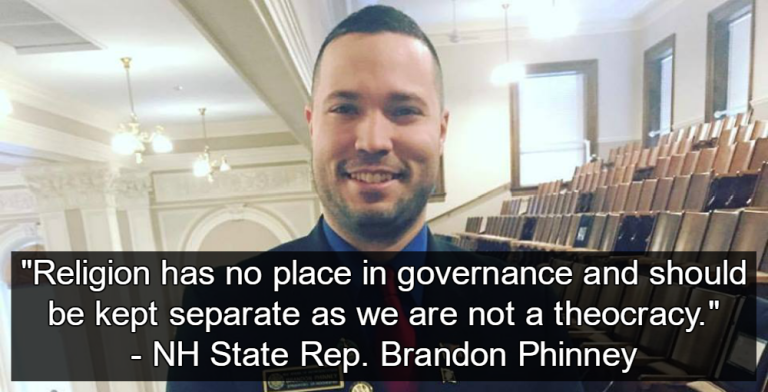
NH Lawmaker Brandon Phinney Defends Church State Separation

NH Lawmaker Brandon Phinney Defends Church State Separation

State Rep. Brandon Phinney is an atheist who rejects “archaic beliefs that deny reality.” The New Hampshire lawmaker recently issued an eloquent letter to the…
by Michael Stone
Read more

Thursday, February 23, 2017

At Wisconsin Juvenile Prisons, Children Face a Nightmare of Solitary Confinement and Abuse

At Wisconsin Juvenile Prisons, Children Face a Nightmare of Solitary Confinement and Abuse

by Valerie Kiebala
At the Lincoln Hills School for Boys (LHS), a juvenile correctional facility in far northern Wisconsin, two entire buildings called the Krueger Unit and the Roosevelt Unit exist solely for the purpose of holding children in solitary confinement for 22 to 23 hours a day. Each unit holds two-dozen isolation cells, which measure seven by […]

Israel blocks EU lawmakers’ entry into besieged Gaza Strip

Israel blocks EU lawmakers’ entry into besieged Gaza Strip

Press TV – February 22, 2017
The Tel Aviv regime has prevented five European parliamentarians from entering the Gaza Strip as the Palestinian enclave remains under an inhumane Israeli siege.
In a statement released on Wednesday, Neoklis Sylikiotis, a Cypriot Member of the European Parliament (MEP), denounced the Israeli obstruction of the lawmakers’ access to the Palestinian coastal sliver.
“The refusal of access to Gaza by the Israeli authorities to the European Parliament on arbitrary grounds is unacceptable,” the statement read.
However, Israel claimed that the MEPs were not among those allowed to enter the Gaza Strip.
Similar European delegations have been barred from Gaza since 2011 though a team led by the head of the European Parliament’s budget committee was allowed to visit once, the statement added.
“What is there to hide from us?” it further asked, condemning Israel’s “systematic” entry bans to Gaza.
It also called on the international community to pressure the Tel Aviv regime to lift the Gaza blockade that has been in place Since June 2007 and affected almost all the two million inhabitants of the enclave.
The World Bank and the United Nations say the Gaza siege has killed all exports and damaged the Palestinian territory’s economy.
Tel Aviv has waged three wars on Gaza since 2008, including the 2014 offensive that left more than 2,200 Palestinians dead.
Israel’s demolition plan ‘unacceptable’
Separately on Wednesday, Robert Piper, the UN humanitarian coordinator for the Palestinian territories, visited the Palestinian Bedouin village of Khan al-Ahmar in the occupied West Bank and voiced alarm over an Israeli plan to demolish structures there.
On Sunday, Israeli forces distributed demolition orders to 40 structures, including tents, huts and a school in the village.
According to Palestinian media outlets, Khan al-Ahmar residents were given until Thursday to vacate the village.
“Khan al-Ahmar is one of the most vulnerable communities in the West Bank struggling to maintain a minimum standard of living in the face of intense pressure from the Israeli authorities to move,” Piper said in a statement. “This is unacceptable and it must stop.”
International bodies and rights groups say Israel’s sustained demolitions of Palestinian homes are aimed at uprooting Palestinians from their native territories, and expropriating more land for the expansion of settlements.
Tel Aviv is has accelerated its land grab and settlement construction activities in the occupied Palestinian lands after pro-Israel US President Donald Trump took office.
Israeli forces have demolished over 48,000 Palestinian homes and buildings since the 1967 occupation of the Palestinian lands, according to the Israeli Committee Against House Demolitions.

Canada's Pledge To Bring In Yazidis Praised By Refugees In Iraq

Canada's promise to resettle hundreds of Yazidis by the end of the year is being welcomed in Iraq, where Yazidi women and girls have endured horrific abuse and persecution at the hands of ISIL.
Among those who have greeted the news with open arms is Saud Khalid, who was kidnapped by ISIL in August 2014 and sold as a sex slave three times before escaping after a year in captivity.

The Trump administration has rescinded protections for transgender students that allowed them to use bathrooms of their choice

The Trump administration has rescinded protections for transgender students that allowed them to use bathrooms of their choice

Wednesday, February 22, 2017 7:58 PM EST


The Trump administration on Wednesday rescinded federal rules that allowed transgender students to use the bathrooms corresponding with their gender identity.
The new policy overruled the advice of President Trump’s education secretary and placed his administration firmly in the middle of the culture wars that many Republicans have tried to leave behind.
Read more »

WH Staffers Fired Over Background Check

WH Staffers Fired Over Background Check


Six White House staffers were escorted off the premises last week after reportedly failing to pass a FBI background check, Politico reported on Wednesday. Among the reportedly removed staffers was White House Chief Digital Officer Gerrit Lansing, who previously led the Republican National Convention’s digital efforts. Additionally, Politico reported, Trump’s director of scheduling Caroline Wiles did not pass the background check and resigned on Friday. The background check on White House employees who cover national security issues, according to Politico, dives into the applicant’s credit score, past substance use, and other matters.

7 Earth-Sized Planets Orbit Nearby Star

7 Earth-Sized Planets Orbit Nearby Star


NASA announced on Wednesday that seven Earth-sized planets have been spotted around a small star in the Aquarius constellation. Michaël Gillon, an astrophysicist at the University of Liège in Belgium, said the star is "so small and cold that the seven planets are temperate, which means that they could have some liquid water and maybe life, by extension, on the surface." The discovery marks the first time that so many planets close to Earth's size have been found in orbit around the same star, called Trappist-1. Scientists have said the news brings new hope that the Milky Way may resemble our own home and even could spur on the hunt for alien life.

Report: Kellyanne Was Sidelined from TV

Report: Kellyanne Was Sidelined from TV


White House spokeswoman Kellyanne Conway was sidelined from appearing on television in the wake of her on-air remarks contradicting official comments on the Michael Flynn controversy, CNN reported on Wednesday. Conway has not appeared on television since remarking last week that Flynn offered to resign in the wake of his scandal surrounding his discussion of sanctions with a Russian ambassador. That same day, however, the White House officially said President Trump asked Flynn to resign. Conway was “off message,” a White House source told CNN. “Clearly they're having much more of a drama-free week,” another source close to the White House said. “Having Kellyanne off television is helping them.” Conway had also come under fire the week prior for openly promoting Ivanka Trump’s clothing line during an interview with Fox News—an ethical violation, as suggested by the House Oversight Committee’s bipartisan leadership.

Trump on Slavery: ‘Boy, That’s Not Good’

Trump on Slavery: ‘Boy, That’s Not Good’


President Trump on Wednesday visited the National Museum of African American History and Culture and was reportedly moved to audibly comment on the horrific nature of slavery during his tour. Martin Luther King Jr.’s niece Alveda King accompanied the president and, according to the Atlanta Journal-Constitution, said that when Trump came upon a stone auction block for selling slaves, he commented: “Boy, that is just not good. That is not good.” Later, when he saw a set of shackles used on slave children, he said, according to King: “That is really bad. That is really bad.”

Why Pence Had to Defend Jewish Graves

Why Pence Had to Defend Jewish Graves

Why Pence Had to Defend Jewish Graves
BY Jay Michaelson
The president is not an anti-Semite, but he is the head of an anti-Semitic movement.

Locked Up by ICE With a Brain Tumor

Locked Up by ICE With a Brain Tumor

Locked Up by ICE With a Brain Tumor
BY Betsy Woodruff
Sara was locked up by ICE after her asylum claim was rejected by an immigration judge. Then she got sick.

Wednesday, February 22, 2017

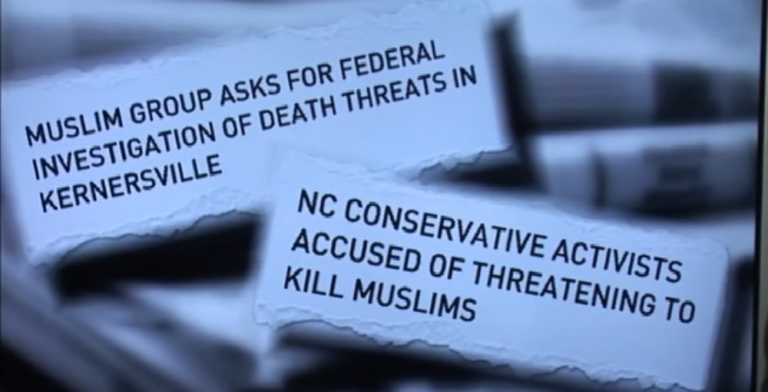
North Carolina Conservatives [Trumpists] Plan To ‘Start Killing’ Muslims

North Carolina Conservatives Plan To ‘Start Killing’ Muslims

Conservative activists in North Carolina are under investigation after making death threats against Muslims. ABC reports the FBI is “looking into reports of death threats…
by Michael Stone
Read more

Pro-Trump Group Is M.I.A.

Pro-Trump Group Is M.I.A.
BY Gideon Resnick
They were supposed to rally Trump’s base and help push his agenda. But in these early, early days of the administration, they’re nowhere to be found.

Nikki Haley Calls Apartheid Israel ‘the one true democracy in the Middle East’

Nikki Haley Calls Apartheid Israel ‘the one true democracy in the Middle East’

By Richard Edmondson | Fig Trees and Vineyards | February 21, 2017
Out of all of Trump’s appointees, Nikkie Haley is probably one of the worst. Formerly a governor of South Carolina, Haley is the current US ambassador to the United Nations. That’s her in the video above giving a presentation at the UN last Thursday.
I’m not sure how much Haley knows about international law. According to Wikipedia, she graduated from Clemson University with a Bachelor of Science degree in accounting. How she ended up as UN ambassador, after criticizing Trump in the general election, is unclear. *
At any rate, Haley seems fully unaware that Israeli settlements are illegal under international law. Nor does she seem to comprehend why other UN-member states might press for resolutions seeking to call Israel to account, both for its settlements as well as its 50-year occupation of the West Bank–land universally recognized as necessary for a Palestinian state. So perhaps she is simply uninformed and does not understand the nature of Israel’s occupation or its devastating impact upon the lives of those forced to live under it. Or at least that’s one possibility.
The other possibility, of course, is that Haley does understand these things… and that she simply believes Israel is exceptional and should not have to follow the same laws and international standards that apply to other states. If so, apparently in Israel are those who would agree with her. Less than a week after her talk at the UN–in which she accused the body of a “prejudiced approach to Israeli-Palestinian issues”–an Israeli military court handed down an 18-month sentence to an Israeli soldier who carried out an execution-style slaying of a wounded Palestinian in March of last year. There was no doubt the soldier was the one who pulled the trigger. The shooting was captured live on video. The sentence of 18 months he received for killing a Palestinian is lighter than what Palestinian children are often given for throwing stones.
* Incredibly, Haley also voiced criticism of Trump–over his stance on Russia–during her congressional confirmation hearings back in January. At that time she accused Russia of “war crimes,” and said, “They (the Russians) have done some terrible atrocities.”

Ambassador Nikki Haley is Completely Clueless

Ambassador Nikki Haley is Completely Clueless

By Daniel McAdams | Ron Paul Institute | February 21, 2017
Just when we thought the great national embarrassment of a UN Ambassador Samantha Power was over, we are suddenly faced with a new US Ambassador to the United Nations, Nikki Haley, who almost makes Ms. Power look like a giant in world affairs and diplomacy.
Addressing the UN Security Council Open Debate on Conflicts in Europe today, Ambassador Haley managed to get nearly every single point spectacularly wrong while mixing in the most banal of platitudes to further deaden the delivery.
Said Haley:
It can be tempting to take Europe’s peace and security for granted. Europe is a continent of strong, stable democracies. And Europe is a continent of flourishing economies that benefit from close cooperation.
But Europe faces serious challenges – most acutely, Russia’s attempts to destabilize Ukraine and infringe upon Ukraine’s sovereignty and territorial integrity.
How exactly is Russia attempting to destabilize Ukraine? It was Russia, after all, and not the US, which called together the opposing sides two years ago to hammer out the “Minsk II” ceasefire and reconciliation agreement. Was not that in fact a stabilizing move rather than a destabilizing move?
Haley continues:
More than three years ago, the Ukrainian people took to the streets to speak out against political oppression and corruption. These protesters demanded freedom, democracy, and respect for the rule of law, and they succeeded in creating a new Ukraine.
That is not all what happened. It was the “protestors” who started the killing. They targeted police officers to provoke a response and thus add fuel to the simmering flame of months long protests in 2014. Russian propaganda, you say? Not at all. The killers went on television to brag about it!
Here is the story of one of the cop killers, Ivan Bubenchik, as reported in Foreign Policy magazine (hardly a pro-Russia outlet) and told on camera to Ukraine’s Hromadske TV station:
To create a word of mouth effect, you have to shoot two or three [police] commanders I only picked two. And after that, there was no need to kill anyone else, so I aimed at the legs.
Does Nikki Haley support killing police officers?
Another report — this time in the BBC — told the same story. It was Nikki Haley’s peaceful protestors who started the violence by shooting at police:
The protest leaders, some of whom now hold positions of power in the new Ukraine, insist full responsibility for the shootings lies with the security forces, acting on behalf of the previous government.
But one year on, some witnesses are beginning to paint a different picture.
‘I was shooting downwards at their feet,’ says a man we will call Sergei, who tells me he took up position in the Kiev Conservatory, a music academy on the south-west corner of the square.
‘Of course, I could have hit them in the arm or anywhere. But I didn’t shoot to kill.’
Sergei says he had been a regular protester on the Maidan for more than a month, and that his shots at police on the square and on the roof of an underground shopping mall, caused them to retreat.
Does Nikki Haley believe shooting police officers is justified as long as you’re demanding “respect for the rule of law”?
In fact, the overthrow of the government in Ukraine was not at all set in motion by the Ukrainian people. It was planned in Washington and executed in the streets of Kiev, where US policymakers openly urged an overthrow of the elected Ukrainian government.
It is established fact that US Assistant Secretary of State Victoria Nuland was on the streets of Kiev with US Ambassador to Ukraine Geoffrey Pyatt meeting with the protesters, encouraging them, and handing out food. Later she was caught in a phone call with the US Ambassador plotting in detail the overthrow of the government and how to replace it with Washington’s picks.
Senator John McCain (R-AZ) was also on the streets of Kiev during the early stages of the coup. He was actively supporting the overthrow of Ukraine’s legal government. Said McCain:
We are here to support your just cause, the sovereign right of Ukraine to determine its own destiny freely and independently. And the destiny you seek lies in Europe…
Later on CNN, McCain admitted his role in the coup, stating:
What we’re trying to do is try to bring about a peaceful transition here…
How would Senator McCain react were a Russian member of parliament appear in the midst of a Washington, D.C. riot urging “a peaceful transition here”?
Trump’s Ambassador to the UN continued:
But Russia has tried to prevent the change that the Ukrainian people demanded. Russia occupied Crimea and attempted to annex this piece of Ukrainian territory – an act the United States does not recognize.
That is also demonstrably false. Russia did not “occupy” Crimea because the Russian military was already in Crimea! Russia had leased the naval base in Crimea from the Ukrainian government until 2042. The troops were already there. Russia did not attempt to annex Crimea, but rather a referendum was held in which, according to the BBC, 90 percent of the residents voted to rejoin Russia (of which they had been a part since the 18th century).
Surely this is fake news! Why would Crimeans vote to leave Ukraine and join Russia? In fact Russians make up more than 65 percent of the population of Crimea and when the US-backed coup brought to power a vehemently anti-Russian government in Kiev was it really so surprising that the people would look for the exit signs?
Haley continues:
Russia then armed, financed, and organized separatist forces in eastern Ukraine, leading to a devastating and senseless conflict that has cost more than 10,000 lives.
Again untrue. The rebellion in eastern Ukraine was fueled by the US-backed coup in Kiev. Eastern Ukraine is predominantly Russian-speaking and in some parts of the region 96 percent voted for the president ousted with US support. As one might expect, unrest follows when one’s president is overthrown with assistance from an outside power. And it was the US who did the arming, financing, and organizing the unelected coup forces who took power in Kiev.
More Haley:
The scenes of destruction from the town of Avdiivka in recent weeks show the consequences of Russia’s ongoing interference in Ukraine.
Avdiivka fell under attack after the Kiev forces advanced into the no-man’s land separating the opposing sides. Ukrainian deputy defense minister Pavlovaky admitted that “meter by meter, step by step, whenever possible our boys have been advancing.”
You get the point. US Ambassador to the UN Nikki Haley has no clue what is happening in eastern Ukraine and so has just dusted off the dusty old talking points of the Obama Administration.
While on the campaign trail last year, Donald Trump sharply (and correctly) criticized the Obama Administration’s militaristic foreign policy. At the time Trump said:
…unlike other candidates for the presidency, war and aggression will not be my first instinct. You cannot have a foreign policy without diplomacy. A superpower understands that caution and restraint are really truly signs of strength.
He continued by calling for new people and new approaches to foreign policy:
My goal is to establish a foreign policy that will endure for several generations. That’s why I also look and have to look for talented experts with approaches and practical ideas, rather than surrounding myself with those who have perfect résumés but very little to brag about except responsibility for a long history of failed policies and continued losses at war. We have to look to new people.
Well, Mr. President, I am sorry to have to inform you of this, but when it comes to Ambassador Nikki Haley, you may technically have “new people” in positions but you most certainly do not have new ideas. You have failed former ambassador Samantha Power’s stale, regurgitated talking points. Enough!

Zionist Entity Poisoning Palestinians in West Bank

Zionist Entity Poisoning Palestinians in West Bank: Fact-Finding Mission

Al-Manar | February 22, 2017
An international fact-finding mission concludes that the trade manufacture and use of toxic pesticides in Israeli illegal settlements result in human rights violations and contribute to the food insecurity in the Occupied West Bank.
Pesticide run-off from agricultural operations and hazardous wastes from the manufacture of agrochemicals inside the illegal settlements poison Palestinian farms, livestock, and water sources, the investigators learned, according to Environment News Service website.
Dumping hazardous wastes in Palestinian territory has been documented, including in areas with a high concentration of schools.
The joint mission, conducted in May 2016, was led by the Arab Group for the Protection of Nature, APN, based in Amman, and the PAN Asia Pacific, PANAP, based in Malaysia, one of five regional centers of the Pesticide Action Network.
The investigation reveals the presence of highly hazardous pesticides banned by the Palestinian Authority, but illegally traded into the Occupied Palestinian Territories – pesticides such as endosulfan and Dukatalon, a mix of paraquat and diquat.
The two reports that came out of the investigation found that 50 percent of pesticides in Palestine are illegal, and that five metric tons of banned pesticides have been confiscated since 1995.
The Palestinian Authority is in no position to dispose of these chemicals safely, and the Zionist entity refuses to take them back, investigators found.

The West’s Moral Hypocrisy on Yemen

The West’s Moral Hypocrisy on Yemen

By Jonathan Marshall | Consortium News | February 21, 2017
Only a few months ago, interventionists were demanding a militant response by Washington to what George Soros branded “a humanitarian catastrophe of historic proportions” — the killing of “hundreds of people” by Russian and Syrian government bombing of rebel-held neighborhoods in the city of Aleppo.
Leon Wieseltier, a senior fellow at the Brookings Institution and former New Republic editor, was denouncing the Obama administration as “a bystander to the greatest atrocity of our time,” asserting that its failure to “act against evil in Aleppo” was like tolerating “the evil in Auschwitz.”
How strange, then, that so many of the same “humanitarian” voices have been so quiet of late about the continued killing of many more innocent people in Yemen, where tens of thousands of civilians have died and 12 million people face famine. More than a thousand children die each week from preventable diseases related to malnutrition and systematic attacks on the country’s food infrastructure by a Saudi-led military coalition, which aims to impose a regime friendly to Riyadh over the whole country.
“The U.S. silence has been deafening,” said Philippe Bolopion, deputy director for global advocacy at Human Rights Watch, last summer. “This blatant double standard deeply undermines U.S. efforts to address human rights violations whether in Syria or elsewhere in the world.”
Official acquiescence — or worse — from Washington and other major capitals is encouraging the relentless killing of Yemen’s civilians by warplanes from Saudi Arabia and its allies. Last week, their bombs struck a funeral gathering north of Sanaa, Yemen’s capital, killing nine women and a child and injuring several dozen more people.
A day earlier, officials reported a deadly “double-tap” airstrike, first targeting women at a funeral in Sanaa, then aimed at medical responders who rushed in to save the wounded. A United Nations panel of experts condemned a similar double-tap attack by Saudi coalition forces in October, which killed or wounded hundreds of civilians, as a violation of international law.
The Tragedy of Mokha
On Feb. 12, an air strike on the Red Sea port city of Mokha killed all six members of a family headed by the director of a maternal and childhood center. Coalition ground forces had launched an attack on Mokha two weeks earlier.
Xinhua news agency reported, “the battles have since intensified and trapped thousands of civilian residents in the city, as well as hampered the humanitarian operation to import vital food and fuel supplies . . . The Geneva-based UN human rights office said that it received extremely worrying reports suggesting civilians and civilian objects have been targeted over the past two weeks in the southwestern port city . . . Reports received by UN also show that more than 200 houses have been either partially damaged or completely destroyed by air strikes in the past two weeks.”
The U.N.’s humanitarian coordinator further reported that “scores of civilians” had been killed or wounded by the bombing and shelling of Mokha, and that residents were stranded without water or other basic life-supporting services.
That could be Aleppo, minus only the tear-jerking photos of dead and wounded children on American television. However, unlike Syria, Yemen’s rebels don’t have well-financed public relations offices in Western capitals. They pay no lip service to the United States, democracy, or international human rights. Their foe Saudi Arabia is a friend of Washington, not a long-time adversary. In consequence, few American pundits summon any moral outrage at the Saudi-led coalition, despite findings by a United National Panel of Experts that many of its airstrikes violate international law and, in some cases, represent “war crimes.”
Aiding and Abetting
The United States hasn’t simply turned a blind eye to such crimes; it has aided them by selling Saudi Arabia the warplanes it flies and the munitions it drops on Yemeni civilians. It has also siphoned 54 million pounds of jet fuel from U.S. tanker planes to refuel coalition aircraft on bombing runs. The pace of U.S. refueling operations has reportedly increased sharply in the last year.
The Obama administration initially supported the Saudi coalition in order to buy Riyadh’s reluctant support for the Iran nuclear deal. Over time, Saudi Arabia joined with anti-Iran hawks to portray Yemen’s rebels as pawns of Tehran to justify continued support for the war. Most experts — including U.S. intelligence officials — insist to the contrary that the rebels are a genuinely indigenous force that enjoys limited Iranian support at best.
As I have documented previously, all of the fighting in Yemen has damaged U.S. interests by creating anarchy conducive to the growth of Al Qaeda extremists. They have planned or inspired major acts of terrorism against the West, including an attempt to blow up a U.S. passenger plane in 2009 and a deadly attack on the Parisian newspaper Charlie Hebdo in January 2015. The Saudis tolerate them as Sunni allies against the rebels, in the name of curbing Iran.
Though the Obama administration is gone, the Trump administration is flush with ideologues who are eager to take a stand against Tehran through Yemen and look tough on “terrorism.” Within days of taking office, President Trump approved a commando raid targeting an alleged Al Qaeda compound in central Yemen that went awry, killing an estimated 10 women and children. The administration has also diverted a U.S. destroyer to patrol Yemen’s coast.
Secretary of State Rex Tillerson, to his credit, has cited “the urgent need for the unfettered delivery of humanitarian assistance throughout Yemen,” according to a department spokesman. But no amount of humanitarian aid will save Yemen’s tormented people from the bombs made in America and dropped from U.S.-made warplanes, with little protest from Washington’s so-called “humanitarian interventionists.”

Appeals Court Says Filming The Police Is Protected By The First Amendment

Appeals Court Says Filming The Police Is Protected By The First Amendment

from the another-circuit-added-to-the-list dept

In news that will surprise no one, police officers decided they must do something about someone filming the police department building from across the street. That's where this Fifth Circuit Court of Appeals decision begins: with a completely avoidable and completely unnecessary assertion of government power.
Phillip Turner was filming the police department. He was accosted by two officers (Grinalds and Dyess). Both demanded he provide them with identification. He refused to do so. The officers arrested him for "failure to identify," took his camera, and tossed him in the back of a squad car. Given the circumstances of the initial interaction, it's surprising the words "contempt of cop" weren't used on the official police report. From the opinion [PDF]:
Grinalds asked Turner, “How’s it going, man? Got your ID with you?” Turner continued videotaping, and Grinalds repeatedly asked Turner if he had any identification. Turner asked the officers whether he was being detained, and Grinalds responded that Turner was being detained for investigation and that the officers were concerned about who was walking around with a video camera. Turner asked for which crime he was being detained, and Grinalds replied, “I didn’t say you committed a crime.” Grinalds elaborated, “We have the right and authority to know who’s walking around our facilities.”
Grinalds again asked for Turner’s identification, and Turner asked Grinalds, “What happens if I don’t ID myself?” Grinalds replied, “We’ll cross that bridge when we come to it.” Grinalds continued to request Turner’s identification, which Turner refused to provide. Grinalds and Dyess then “suddenly and without warning” handcuffed Turner and took his video camera from him, and Grinalds said, “This is what happens when you don’t ID yourself.”
Turner asked to speak to their supervisor. Given that this happened right across the street from the department, Turner didn't have to wait very long. A supervisor arrived and came to at least one correct conclusion:
Lieutenant Driver identified himself as the commander. Driver asked Turner what he was doing, and Turner explained that he was taking pictures from the sidewalk across the street. Driver asked Turner for his ID, and Turner told the lieutenant that he did not have to identify himself because he had not been lawfully arrested and that he chose not to provide his identification. Driver responded, “You’re right.”
Texas police officers love to misread the state's "failure to identify" statute. It doesn't say what they think it does… or what they want to believe it does. A former cop-turned-law student has a full explanation here, but suffice to say, cops cannot arrest someone for refusing to ID themselves -- at least not in Texas. The charge can be added after an arrest (if the refusal continues), but it can't be the impetus for an arrest.
After some discussion between the officers, Turner was released and his camera was given back. Turner filed a civil rights lawsuit. The lower court granted immunity to the officers on all allegations. The Fifth Circuit, however, refuses to go as far. And in doing so, it actually takes it upon itself to address an issue it easily could have avoided: whether the First Amendment covers the filming of public servants, specifically law enforcement officers.
First, the court asks whether the right to film police was "clearly established" at the time the incident took place (September 2015). It can't find anything that says it is.
At the time in question, neither the Supreme Court nor this court had determined whether First Amendment protection extends to the recording or filming of police. Although Turner insists, as some district courts in this circuit have concluded, that First Amendment protection extends to the video recording of police activity in light of general First Amendment principles, the Supreme Court has “repeatedly” instructed courts “not to define clearly established law at a high level of generality”: “The general proposition, for example, that an unreasonable search or seizure violates the Fourth Amendment is of little help in determining whether the violative nature of particular conduct is clearly established.” Thus, Turner’s reliance on decisions that “clarified that [First Amendment] protections . . . extend[] to gathering information” does not demonstrate whether the specific act at issue here—video recording the police or a police station—was clearly established.
The court doesn't leave it there, although it could have. The court notes that there's a circuit split on the issue, but just because the issue's far from decided doesn't mean courts have not recognized the right exists. It points to conclusions reached by the First and Eleventh Circuit Appeals Courts as evidence the right to film police has been acknowledged. Even so, there's not enough clarity on the issue to remove the officers' immunity.
We cannot say, however, that “existing precedent . . . placed the . . .constitutional question beyond debate” when Turner recorded the police station. Neither does it seem that the law “so clearly and unambiguously prohibited [the officers’] conduct that ‘every reasonable official would understand that what he is doing violates [the law].’” In light of the absence of controlling authority and the dearth of even persuasive authority, there was no clearly established First Amendment right to record the police at the time of Turner’s activities.
This is where the opinion gets interesting. While many judges would leave a trickier, somewhat tangential issue open and unanswered, the Fifth Circuit Appeals Court decides it's time for it to set some precedent.
We conclude that First Amendment principles, controlling authority, and persuasive precedent demonstrate that a First Amendment right to record the police does exist, subject only to reasonable time, place, and manner restrictions.
[...]
To be sure, “[s]peech is an essential mechanism of democracy, for it is the means to hold officials accountable to the people. The right of citizens to inquire, to hear, to speak, and to use information to reach consensus is a precondition to enlightened self-government and a necessary means to protect it.” Filming the police contributes to the public’s ability to hold the police accountable, ensure that police officers are not abusing their power, and make informed decisions about police policy. Filming the police also frequently helps officers; for example, a citizen’s recording might corroborate a probable cause finding or might even exonerate an officer charged with wrongdoing.
In the Fifth Circuit -- joining the First and Eleventh Circuits -- the First Amendment right to film police has been asserted. Unfortunately, the issue still remains mostly unsettled, and there's currently nothing in front of the Supreme Court that would set national precedent. Unfortunately, the decision doesn't help Turner with his First Amendment claim, but it will help others going forward.
The court also reverses immunity on one of Turner's Fourth Amendment claims. While it finds the officers were justified in questioning him, they went too far when they arrested him. First, as pointed out above, the "failure to identify" law can't be used to predicate an arrest. And, after questioning him, the officers still had nothing approaching the probable cause they needed to make a warrantless arrest. Even though Turner was detained in the back of the squad car for only a short period of time, the fact that he was obviously not free to go makes it an arrest under the Fourth Amendment.
Strangely, the dissent, written by Judge Edith Brown, claims the Appeals Court has no business setting precedent. In her opinion, the nation's second-highest courts should stand idly by and wait for the Supreme Court to do the work.
The majority asserts, unconnected to the particular facts and unnecessary to the disposition of this case, that “a First Amendment right to record the police does exist, subject only to reasonable time, place, and manner restrictions.” The majority derives this general right to film the police from “First Amendment principles, controlling authority, and persuasive precedent.” But the Supreme Court has repeatedly reversed attempts to define “clearly established law” at such “a high level of generality.” White, 137 S. Ct. at 552.
The judge narrowly defines Turner's filming to ensure it would never fall under this supposedly "broad" definition of the right. She says the Appeals Court defines the protection as covering "filming police." But Turner wasn't doing that.
To the extent there is any consensus of persuasive authority, those cases focus only on the narrow issue of whether there is a First Amendment right to film the police “carrying out their duties in public.” E.g., Glik v. Cunniffe, 655 F.3d 78, 82 (1st Cir. 2011). Turner did not allege that he filmed police officers conducting their public duties, but rather that he filmed a police station.
Somehow, filming police officers as they enter and exit a public building is not "filming police carrying out their duties in public." Remarkably, Judge Brown says there may be "reasonable" security concerns that could Constitutionally prevent Turner's actions.
The majority does not determine that the officers here violated Turner’s First Amendment rights—perhaps because it would be reasonable for security reasons to restrict individuals from filming police officers entering and leaving a police station.
If police officers are entering and exiting a building from doors clearly viewable by the public from a public area, the officers obviously aren't that concerned about their "security." If so, they would use an entrance/exit members of the public can't see or don't have access to. If the Fourth Amendment doesn't protect the privacy of citizens in public areas, the same public areas can't be given a heightened privacy protection that only covers public servants.
Unsurprisingly, Judge Brown thinks Turner's involuntary stay in the back of a squad car could reasonably be viewed as Turner just hanging out there waiting to speak to a supervisor:
Because Turner himself requested a supervisor, a reasonable police officer in that situation could believe that waiting for the supervisor to arrive at the scene did not transform Turner’s detention into a de facto arrest. At the very least, Officers Grinalds and Dyess did not act objectively unreasonably in waiting for the requested supervisor—especially because Lieutenant Driver had to come from the Fort Worth Police Station across the street.
Except that most people "waiting for a supervisor" don't do so while:
a.) handcuffed
b.) sitting in the back of a locked squad car
The length of the detention doesn't matter. And it was ultimately the supervisor's arrival that sprung Turner. If not for the arrival of the supervisor -- who immediately recognized Turner couldn't be arrested for refusing to ID himself -- Turner would undoubtedly have spent an even longer period being detained, if not taken into the PD and processed.
The good news for Turner is that his sole remaining Fourth Amendment claims -- the wrongful arrest -- lives on. But the bigger win -- the First Amendment protections confirmation -- helps everyone else but him.

Trump national security adviser will face Senate vote

Trump national security adviser will face Senate vote

February 21, 2017 (Photo Credit: Nicholas Kamm/AFP/Getty Images)
WASHINGTON — The president’s national security adviser doesn’t usually need Senate confirmation, but for President Trump’s pick, Lt. Gen. H.R. McMaster, it will be different.

That’s because the Senate has a unique role in the confirmation of the military's most senior officials. For McMaster, a senior flag officer, to keep his rank and change jobs, the law requires the Senate to reconfirm him.

Amid an already drawn-out Cabinet confirmation process, the upper chamber will have yet another crack at the Trump administration. 

"General McMaster does not require Senate confirmation to serve as National Security Adviser," a Senate Armed Services Committee aide confirmed in a statement to Defense News. "However, if it is the president’s desire that General McMaster serve as National Security Adviser while in his current grade of lieutenant general, the law requires that General McMaster would have to be reappointed by the president and reconfirmed by the Senate in that grade for his new position."

A Senate Armed Services Committee confirmation hearing is unlikely, but McMaster would be asked to agree to testify in the future because of his rank, Arnold Punaro, a retired Marine general and former SASC staff director, said Tuesday. Such testimony could spotlight policy splits between the outspoken general and the unorthodox president. 

“All three- and four-stars have to agree to give their ‘personal’ views, if asked, even if they differ from the administration in power. They have to agree to testify—when typically the national security advisor hardly ever testifies, and they always decline when pushed,” Punaro said.

McMaster was director of the Army Capabilities Integration Center and the head of the "futures" center at Training and Doctrine Command. He earned a reputation for outspokenness with his 1997 book, “Dereliction of Duty,” which questioned political and military leadership during Vietnam, and in 2014 made Time Magazine's "100 most influential" list.

Trump fired his previous national security adviser, retired Lt. Gen. Michael Flynn, a week ago, after revelations that he had misled Vice President Mike Pence about discussing sanctions with Russia's ambassador to the US during the presidential transition. Trump said in a news conference Thursday he did not believe Flynn had done anything illegal. 

Retired Vice Adm. Robert Harward turned down the job earlier this month. Politico reported that Harward wanted commitments the National Security Council would be fully in charge of security matters, not Trump's political advisers. And he wanted to be able to select his own staff.

On Tuesday, White House spokesman Sean Spicer characterized those reports as "rumors" and said they were "100 percent false," as Harward declined due to family and financial concerns. McMaster, Spicer said, has "full authority to structure the office to his desires."

Spicer said McMaster will "stay on active duty," and that he "would not require Senate confirmation," but did not offer comment on the process beyond that.

Military officers above two-star are appointed to their jobs by the president, and confirmed by the Senate. US Code Title 10, Section 601, requires the officer to be reconfirmed by the Senate in that grade for a new position within 60 days—or they will revert to a two-star.

There are two scenarios in which McMaster would not need to seek Senate confirmation. He could choose to serve as a two-star major general or retire from the military and serve as a civilian.

For McMaster to remain on active duty, as previous national security advisor Colin Powell did, the SASC will have to act first. It must report the nomination to the Senate, and from there, it will go on the executive calendar.

Senate Armed Services Chairman John McCain, R-Ariz., is likely to fast-track confirmation, as he and most in the national security establishment believe that McMaster is a major positive addition to the Trump team. McCain gave Trump “great credit” for the pick, saying, “I could not imagine a better, more capable national security team than the one we have right now.”  

In 1987, before Powell took the job, then-Senate Armed Services Chairman Sam Nunn, D-Ga., and then-Ranking Member John Warner, R-Va., voiced reservations on the Senate floor about a military officer taking the job. Nunn questioned whether Powell would face a conflict between his responsibilities to the president and his dependence on the defense secretary for promotion. 

At the time, the committee investigating the Iran-Contra affair recommended against an active-duty officer serving in the job. Still Powell was approved unanimously.

For McMaster, "I would hope like Powell it would be unanimous and I would expect that it should be," Punaro said.