[{(o)}]|[{(o)}]|[{(o)}]|[{(o)}
GAY WISDOM for Daily Living...
from White Crane Institute
Exploring Gay Wisdom
& Culture for over 20 Years!
[{(o)}]|[{(o)}]|[{(o)}]|[{(o)}
Today In Gay History!
Sunday, October 9, 2011

1835 – CAMILLE SAINT-SAËNS, the French composer, was born on this date. The French composer, organist, conductor, and pianist, was known especially for his orchestral works The Carnival of the Animals, Danse Macabre, Samson et Dalila, and Symphony No. 3 (Organ Symphony). Saint-Saëns began his musical career as a child prodigy and pursued a life in music until he died at age 86. He was a pianist and organist who composed works, as he put it, "as an apple-tree produces apples." He brought forth prodigious quantities of musical apples, and if some, to modern ears, are a little green or even rotten, they are more than made up for by the large number of perfect polished fruit. It cost a great deal of money to be a full-time composer, and Saint-Saëns was no struggling artist in a rooftop garret. He was supported by a large behest from an older friend, Henri Libon, and the nature of their friendship has always been open to interpretation.
There's no interpretation necessary, however, to understand Saint- Saëns own sexuality. Though he is reported to have had a marked preference for Algerian boys, he was a devotee of Parisian pissoirs even in old age. In an amusing memoir, the composer Henri Busser records coaxing his ancient colleague, now reduced to merely peeking, from the local pissoirs. In 1875, Saint-Saëns married Marie-Laure Truffot and they had two children, André and Jean-François, who died within six weeks of each other in 1878. Saint-Saëns left his wife three years later. The two never divorced, but lived the rest of their lives apart from one another.
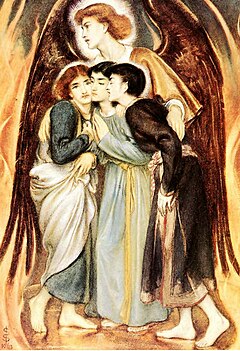
1840 - on this date the great Pre-Raphaelite artist SIMEON SOLOMON was born (d. 1905).
Solomon lived as an openly Gay man in a time when it was not socially acceptable to do so. He also paid the price later on. He and Algernon Swinburne were frequently seen chasing each other naked through Dante Gabriel Rosetti's house. In 1873 his career was cut short when he was arrested in a public toilet in London and charged with indecent exposure and attempting to commit sodomy. He was sentenced to serve eighteen months' hard labor in prison, but this was later reduced to police supervision. He fled to the French Third Republic. He was however arrested again in 1874, after which he was sentenced to spend three months in prison. Upon his arrest, though, Swinburne turned into a fair weather friend and would no longer deign to be seen with Solomon, much less romp naked through Dante's house. For a time, Solomon was lovers with Eton master and Cambridge tutor, Oscar Browning who himself was forced to leave both schools because of his own little homosexual scandals.
For most of the 20th century Solomon's art had never been collected and published, probably because most of it is erotic and explicitly Gay, much as the artist's name seemed to have been expunged from all but the most complete art reference books. A sad loss as they were treasured in their time. In Oscar Wilde's long prison letter to Lord Alfred Douglas, De Profundis, Wilde writes of his bankruptcy: "That all my charming things were to be sold: my Burne-Jones drawings: my Whistler drawings: my Monticelli: my Simeon Solomons: my china: my Library…"
Examples of his work are now on permanent display at the Victoria and Albert Museum and at Leighton House. In December 2005/January 2006, there was an important retrospective of his work, held at the Birmingham Museum and Art Gallery, and in London at the Ben Uri Gallery in October and November 2006. If you're not familiar with his work, I highly recommend a Google image search for "Simeon Solomon." Gorgeous work by a brilliant man.

1888 – on this date, one of the largest man-made phallic objects in the world officially opened to the general public. Of course we mean the WASHINGTON MONUMENT in Washington, DC.

1893 - on this date the Brazilian poet and novelist MARIO de ANDRADE was born (d. 1945).
He was also a musicologist, art historian, critic, photographer and one of the founders of Brazilian modernism. Andrade virtually created modern Brazilian poetry with the publication of his Paulicéia Desvairada (Hallucinated City) in 1922. He has had an enormous influence on Brazilian literature in the 20th and 21st centuries, and as a scholar and essayist—he was a pioneer of the field of ethnomusicology—his influence has reached far beyond Brazil.
Andrade was the central figure in the avant-garde movement of São Paulo for twenty years. Trained as a musician and best known as a poet and novelist, Andrade was personally involved in virtually every discipline that was connected with São Paulo modernism, and became Brazil's national polymath. He was the driving force behind the Week of Modern Art, the 1922 event that reshaped both literature and the visual arts in Brazil. After working as a music professor and newspaper columnist he published his great novel, Macunaíma, in 1928. At the end of his life, he became the founding director of São Paulo's Department of Culture, formalizing a role he had long held as the catalyst of the city's—and the nation's—entry into artistic modernity.
Though Andrade was not openly Gay, many of Andrade's friends have reported after his death that he was clearly interested in men (the subject is only reluctantly discussed in Brazil.

1944 - today is the birthday of American singer and LaBelle vocalist NONA HENDRYX. She is also a record producer, songwriter, musician, author, and actress. Hendryx is known for her work as a solo artist as well as for being one-third of the trio Labelle, who had a hit with "Lady Marmalade." Her music has ranged from soul, funk, dance and rhythm and blues to hard rock, art rock and new age. Labelle had emerged from the traditional "girl group" Patti LaBelle and the Bluebells, a quartet that became a trio with Cindy Birdsong's departure for The Supremes. It was manager Vicki Wickham who re-imagined the group as Labelle; as glam rock/space age divas, Labelle created a sound and look previously unheard of for a black, all-female crew, what with the "girl group" pigeon-holing of the time. Hendryx embraced the new concept whole-heartedly (much more so than Patti LaBelle in particular, who stated her own adoration for "big ballads"; bandmate Sarah Dash remained fairly neutral throughout their time together). Hendryx and Wickham paired off on a creative level.
In 2001 she discussed her bisexuality in an interview with The Advocate magazine and has become a Gay-rights activist over the years. In summer 2008, she joined Cyndi Lauper on her True Colors tour, raising awareness of discrimination and the LGBT community and appeared as herself on the Lesbian hit show, The L Word."
Other artists with whom Hendryx has recorded with over the years include: David Johansen, Yoko Ono, Cameo Talking Heads (3 albums, 80's band, Our Daughter's Wedding, Garland Jeffreys, Dan Hartman, Afrika Bambaata (performing a duet of "Giving Him Something He Can Feel" with Boy George), Canadian band Rough Trade, Curtis Hairston, and Graham Parker on the hit single, "Soul Christmas."
[{(o)}]|[{(o)}]|[{(o)}]|[{(o)}


No comments:
Post a Comment