“We Are Not the Worst of the Worst”: One Year Later, What’s Changed for Pelican Bay’s Hunger Strikers?
by Victoria Law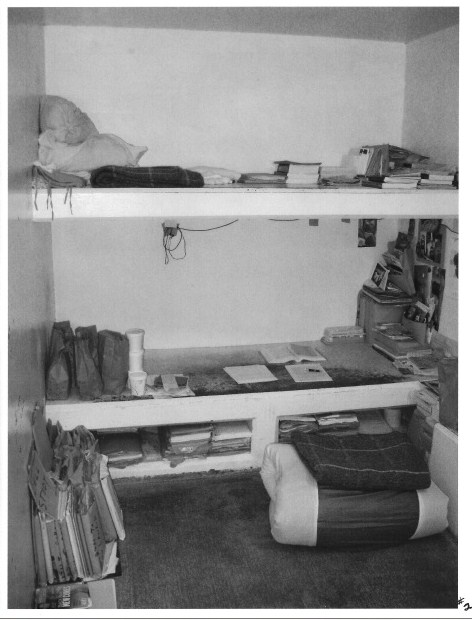
Photos: A cell in the Pelican Bay SHU occupied by hunger striker Todd Ashker.
On
July 8, 2013, 30,000 prisoners refused their meals, launching the
largest mass prison hunger strike in U.S. history. One year later, Todd
Ashker is marking off his twenty-fourth year in Pelican Bay's Security
Housing Unit (SHU). "I'm still alive, kicking and strong in heart and
spirit," he wrote in a June 2014 letter. Ashker is one of the four main
representatives for the hunger strikers and the lead plaintiff in the
class-action suit Ashker v. Brown. Nonetheless, he remains confined in the SHU since his placement there in 1990. He is not alone; as of April 2014, 1,199 people were held in Pelican Bay's SHU. Some have been there for over a decade.
Inside
the SHU, people are locked into windowless cells for at least 22 hours a
day. Prison administrators place them in the SHU either for a fixed
term for violating a prison rule or an indeterminate term for gang
membership. Accusations of gang affiliation often relied on confidential
informants and circumstantial evidence. Hundreds have been confined
within the SHU for over a decade. Until recently, the only way to be
released from the SHU was to debrief, or provide information
incriminating other prisoners, who are then placed in the SHU for an
indeterminate sentence. In 2011, SHU prisoners called for a hunger
strike to protest SHU policies. In 2013, frustrated with the lack of
changes, they called for another hunger strike.
The
call was taken up across California and in out-of-state prisons where
California prisoners are held. Thirty thousand people responded,
refusing meals that first day. Hunger strikers issued five core demands,
including the elimination of “group punishments for individual rules
violations”; changes in the criteria for being “validated” as gang
members, and for “debriefing” from gang status; compliance with the
recommendations of the U.S. Commission on Safety and Abuse in Prisons
regarding an end to long-term solitary confinement; provision of
“adequate food”; and expansion of “constructive programs and privileges
for indefinite SHU prisoners.” The men of Pelican Bay issued forty
additional demands, such as expunging all violations issued for
participation in the 2011 hunger strikes, and prohibiting retaliation
for those participating in the most recent strike.
The
strike ended on September 5, 2013, or Day 60, after California
legislators Loni Hancock, chair of the Senate Public Safety Committee,
and Tom Ammiano, chair of the Assembly Public Safety Committee, issued a
statement of support for the hunger strikers and promised to hold
hearings around SHU placement and long-term solitary confinement.
Changes in Conditions Inside the SHU
 One
of the five core demands during the 2011 and 2013 hunger strikes was
adequate food. After the 2011 hunger strike, Mutope DuGuma charged that
prison staff served inedible food to those in the SHU. More recently, he
reports that the food servings are small, noting that those without
family members able to send them money cannot rely on the (expanded)
canteen items to supplement their meals.
One
of the five core demands during the 2011 and 2013 hunger strikes was
adequate food. After the 2011 hunger strike, Mutope DuGuma charged that
prison staff served inedible food to those in the SHU. More recently, he
reports that the food servings are small, noting that those without
family members able to send them money cannot rely on the (expanded)
canteen items to supplement their meals.
While
prisoners, family members and advocates state that none of the five
core demands have been adequately met, some of the forty supplemental
demands have. Visiting times, for instance, have doubled from ninety
minutes to three hours. For family members driving fourteen hours
from southern California, the increase in visiting time means a lot.
But, notes Mutope DuGuma, who has been in the SHU since 2001, "if you're
so far away from home, it don't matter because your people can't afford
the trip anyway which is anywhere from five hundred dollars for up and
back, if not more." (The increase in visiting times only applies to
Pelican Bay. In Tehachapi, which also has a Security Housing Unit,
visiting continues to be limited to one hour.)
Hunger
strikers also won the right to order an increased number of items from
the canteen. "Imagine being able to order a jalapeno or cheese after
being there [without them] for decades," stated Dolores Canales, whose
son has been in the SHU for thirteen years. She also stated that they
also won the right to order their own underwear rather than wearing
prison-issued underwear that has been worn by countless others. They can
also buy a cup and bowl as well as a handball from the canteen. "Of
course, the families are paying for these items," she added.
"Is
this what they've been fighting for and starving themselves for?"
Canales reflected. "No. But does it make a difference in their lives?
Yes." Both family members and SHU prisoners agree that the five core
demands have yet to be met.


No comments:
Post a Comment