Posted: 03 Oct 2014 01:14 PM PDT

The Aral Sea in 1989 (left), and now (2014)
"This is the first time the eastern basin has completely dried in modern times," Philip Micklin, an Aral Sea expert from Western Michigan University told NASA's Earth Observatory, which captured fresh satellite images of the lake. "And it is likely the first time it has completely dried in 600 years, since Medieval desiccation [drying out] associated with diversion of Amu Darya to the Caspian Sea."
In a bid to drive up production of cotton in nearby steppes, Soviet engineers diverted the Amu Darya and the Syr Darya, the two rivers flowing into the lake, as part of massive irrigation projects for water-hungry crops in the 1950s and '60s.

The Aral Sea in 2000

The Aral Sea in 2009

The Aral Sea in 2014
This particular retreat has been a consequence of poor rainfall in the Pamir Mountains that has exacerbated the shortfall of water flowing into the lake, which lies between Kazakhstan and Uzbekistan, but it could not have happened without the constant decline.
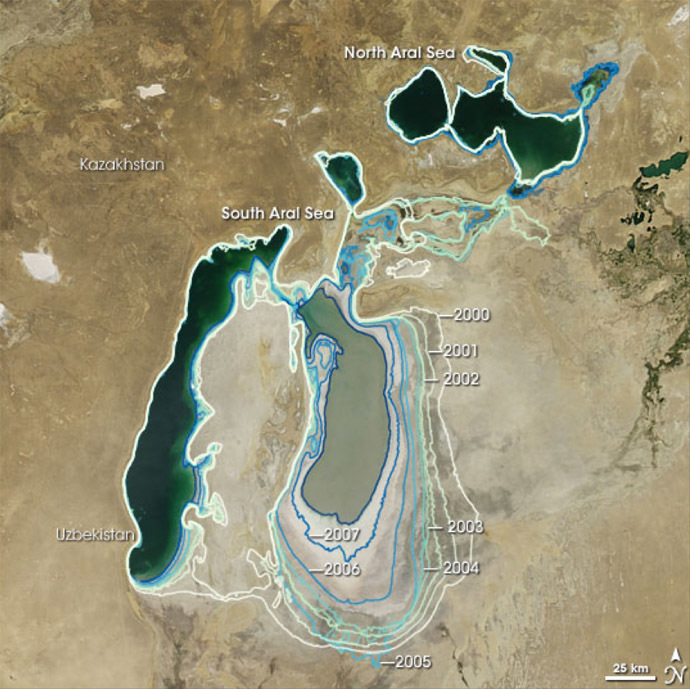
The Aral Sea in 2000-2008
Soviet officials first admitted the impact of their project on the Aral Sea in the 1980s, but little can be done about it currently.

Aral fish factory. The Aral Sea, 06.01.1968
A dam was built with World Bank funds in 2005 to filter water than now flows into the separate northern part of the lake, which has partially recovered, though the water mass is only a small fraction of its previous size.
Source


No comments:
Post a Comment