Torture on Death Row: Court Rules Against Automatic Use of Solitary Confinement for the Condemned
by Aviva Stahl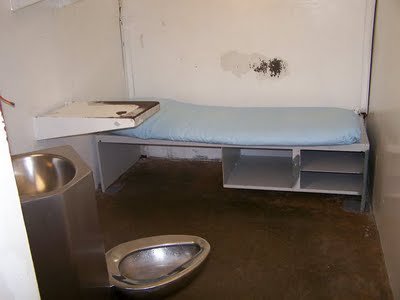
Cell on Texas death row.
The
Supreme Court has ruled that the death penalty itself does not
constitute "cruel and unusual punishment." Yet the treatment of the
condemned is nonetheless subject to Eighth Amendment protections, as
well as Fourteenth Amendment guarantees of due process.
In
the past few years, this ironic legal reality has been the subject of a
renewed national debate centering on execution methods. The European
drug companies that U.S. states have historically relied on to provide
the materials for lethal injections have refused to replenish supplies.
As a result, states have developed new drug protocols, often
implementing them without testing or research. Last month, Dennis McGuire struggled and gasped for well over ten minutes before he finally died.
But at a recent Senate Judiciary Subcommittee hearing, exoneree Damon Thibodeaux
called attention to a different, rarely-discussed aspect of death row
that he believes also constitutes “torture, pure and simple” – the
conditions of confinement that people endure prior to execution:
“I spent my years at Angola, while my lawyers fought to prove my innocence, in a cell that measured about 8 feet by 10 feet. It had three solid walls all painted white, a cell door, a sink, a toilet, a desk and seat attached to a wall, and an iron bunk with a thin mattress. These four walls are your life. Being in that environment for 23 hours a day will slowly kill you. Mentally, you have to find some way to live as if you were not there. If you cannot do that, you will die a slow mental death and may actually wish for your physical death, so that you do not have to continue that existence. More than anything, solitary confinement is an existence without hope.”
Thibodeaux
was exonerated after spending fifteen years on death row at Angola
State Penitentiary in Louisiana. While his story may be unusual, his
experience of extreme isolation is standard for people facing execution.
A
recent ruling, however, suggests that the federal courts may soon
mandate higher due process protections for individuals sentenced to
death. Last November, U.S. District Court Judge Leonie Brinkema found in
Prieto v. Clark
that the state of Virginia had violated the Constitution by
automatically placing individuals on death row in indefinite isolation.
In January, she rejected a request from state attorneys to delay the implementation of her ruling.
In
her determination, Judge Brinkema describes what people on death row in
Virginia must bear from the time of their sentencing to the time of
their execution:
“Plaintiff's conditions of confinement on death row are undeniably extreme and atypical of conditions in the general population units at [the prison]. He must remain alone in his cell for nearly 23 hours per day… The lights never go out in his cell, although they are scaled back during the overnight hours… Plaintiff is allowed just five hours of outdoor recreation per week…and that time is spent in another cell at best slightly larger than his living quarters… He otherwise has no ability to catch a glimpse of the sky because the window in his cell is a window in name only… Nor can he pass the time in the company of other inmates; plaintiff is deprived of most forms of human contact… His only real break from the monotony owes to a television and compact disc player in his cell and limited interactions with prison officials…”
As
the judge outlines, those on death row are automatically and
permanently placed in solitary confinement – forced to withstand
particularly severe conditions purely as a consequence of their
sentence. This placement is functionally indefinite since it can take
years, or even decades, before individuals exhaust their appeals and
finally face execution. (According to the Bureau of Justice Statistics,
those executed in 2010 had spent an average of 14.8 years on death
row). By contrast, all others incarcerated in Virginia are assigned an
initial security classification based on eight factors, including
several unrelated to their sentences: their history of institutional
violence, escape history, current age, etc.
The Court’s finding in Prieto v. Clark
is that the automatic placement of death row prisoners in solitary
confinement violates their Fourteenth Amendment rights, since they
endure “uniquely severe” conditions without any kind of procedural
protections or stopgap measures.
Judge
Brinkeama concludes that the Virginia prison authorities have two
options: either providing an individualized classification procedure for
each person sentenced to execution, or altering conditions on death row
“such that confinement there would no longer impose an atypical and
significant hardship.”
The court’s ruling comes several months after the publication of an American Civil Liberties Union (ACLU) report
that examined the conditions of confinement endured by those on death
row. As the ACLU notes, this extreme isolation constitutes a “punishment
on top of punishment”:
- Cell size: Most common cell size is 8x10 feet (27% of prisoners), just a bit bigger than the size on an average bathroom.
- Basic comfort: Beds provide in death row cells are made out of: Steel 60%; Concrete 13%; Steel with mattress 9%; Concrete with pad 6%; Metal 6%.
- “Enforced idleness”: States that allow death inmates to exercise for one hour or less: 81%.
- Social isolation: States with mandated no-contact visits for death row inmates: 67%.
- Religious services: States that fail to offer religious services to death row prisoners: 62%.
At
the Senate hearing on solitary confinement last month, Thibodeux told
the Senate Judiciary Subcommittee that he had contemplated ending the
appeals process – despite his innocence – in order to escape his extreme
isolation:


No comments:
Post a Comment