Most smuggled ISIS oil goes to Turkey, sold at low prices – Norwegian report

A newly-leaked report on illegal oil sales by Islamic State (IS, previously ISIS/ISIL), which was ordered to be compiled by Norway, has revealed that most of the IS-smuggled oil has been destined for Turkey, where it is sold off at bargain low prices.
Norwegian
daily Klassekampen leaked details of the report, which was put together
by Rystad Energy, an independent oil and gas consulting firm, at the
request of the Norwegian Foreign Ministry.
“Large amounts of oil have been smuggled across the border to Turkey from IS-controlled areas in Syria and Iraq,” Klassekampen cited the report as saying. “[The]
oil is sent by tankers via smuggling routes across the border [and] is
sold at greatly reduced prices, from $25 to $45 a barrel.”
The
crude is reportedly sold on the black market at greatly reduced prices,
while the Brent benchmark is currently trading at $35-$50 per barrel.
READ MORE: Putin: ISIS financed from 40 countries, including G20 members
To compile the report, which is dated from July, Rystad Energy used its own database as well as sources in the region.
“Exports happen in a well-established black market via Turkey,” the report concluded. “Many
of the smugglers and corrupt border guards, who helped Saddam Hussein
avoid international sanctions, are now helping IS export oil and import
cash.”
In the beginning of December, the Russian Defense
Ministry released evidence which it said shows most of the illegal oil
trade by IS going to Turkey.
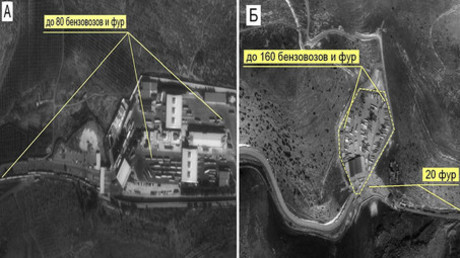
Russia has earlier said it is aware of three main oil smuggling
routes to Turkey, and Deputy Defense Minister Anatoly Antonov presented
video evidence of operations, as well as detailed maps, at a briefing
for journalists.
“Today, we are presenting only some of the
facts that confirm that a whole team of bandits and Turkish elites
stealing oil from their neighbors is operating in the region,” Antonov said, adding that this oil “in large quantities” enters the territory of Turkey via “live oil pipelines,” consisting of thousands of oil trucks.
The data directly implicated Turkish President Recep Tayyip Erdogan in the oil trade with IS. “According
to our data, the top political leadership of the country – President
Erdogan and his family – is involved in this criminal business.”
Ankara has denied the allegations. Erdogan said that nobody had a right to “slander”
Turkey by accusing it of buying oil from Islamic State. Erdogan even
claimed that he will resign if such accusations were proven to be true.
Moreover, the US has defended Turkey, denying any ties between Ankara
and IS.
Last October, US Under Secretary for Terrorism and
Financial Intelligence David Cohen said IS was earning $1 million a day
from oil sales. “According to our information, as of last month,
ISIL was selling oil at substantially discounted prices to a variety of
middlemen, including some from Turkey, who then transported the oil to
be resold. It also appears that some of the oil emanating from territory
where ISIL operates has been sold to Kurds in Iraq, and then resold
into Turkey,” he said.
According to Russian Prime Minister
Dmitry Medvedev, the middlemen in Turkey are not only entrepreneurs, but
also Ankara officials. Turkey is protecting IS because of “direct
financial interest of some Turkish officials relating to the supply of
oil products refined by plants controlled by ISIS.”
These
revelations come as the UN Security Council has passed a resolution
strengthening legal measures against those doing business with terrorist
groups. It stems from a UNSC action taken in February against illegal
trafficking of antiquities from Syria, which threatened sanctions on
anyone buying oil from IS or the Al-Qaeda-linked Al-Nusra Front and
urged that no ransoms be paid to terrorists.


No comments:
Post a Comment