Witness: A Doctor Detained and Tortured in Syria
Amy Braunschweiger
Senior Web Communications Manager amybrauns
Despite the chilly morning air in Berlin, Dr. Sami Sharif
prefers to sit at one of the café’s outside tables, where he can smoke.
He sips his espresso and smiles, as he tells me that when he was
younger, he didn’t want to be a doctor at all, he wanted to study
physics. But in 2011, when he was in his 5th year of medical
school and training in Damascus hospitals, the uprising began in Syria.
“When I realized I could help people, I loved being a doctor.”

© 2015 Amy Braunschweiger
Sami, 27, has a neatly trimmed beard and wears a heavy winter coat, a
gift from his Germany host family. When our conversation got tough for
him, he’d bunch his hands into the pockets. Although he knew his work
was dangerous, he somehow felt invincible, he says. He never thought
he’d be detained and tortured, or that at the urging of his family – he
grew up in Qamishli, in a Kurdish area of Syria – he’d flee his home for
Germany.
A new Human Rights Watch report contains an in-depth examination of
the photos of dead detainees in Syria, taken by a Military Police
photographer referred to as “Caesar,” who had more than 28,000 images
documenting 6,786 dead when he fled Syria. Human Rights Watch uncovered
many of the dead’s names, interviewed their friends and family, as well
as former detainees and medical professionals, to establish possible
causes of death. The bodies of seven of Sami’s friends were among the
Caesar photographs, he said.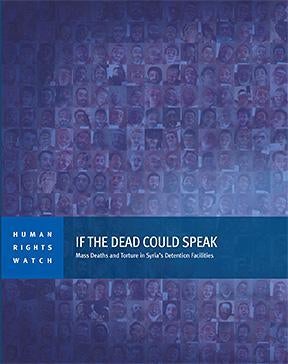
Then, in September 2014, Syrian security forces – the feared mukhabarat - detained his girlfriend, Nada, who he met earlier doing covert medical work. One day, he called her to say good morning, but there was no answer. He called again - no answer. And again. Then her sister called him, crying. “She said the security forces went to her office and took her.”
A secret service agent called him, and said that if he turned himself
in, Nada would be fine, they’d let her go. They told him to meet them
on a busy street in Damascus. “I didn’t want them to torture her,” he
said.
He went to the meeting point, and a black car with darkened windows
pulled up. A big man opened up the driver’s door, got out, said, “Hello,
you can come with us,” and pushed him into the backseat. Someone else
pulled his t-shirt over his head to blindfold him, but not before he saw
Nada’s phone on the seat. The insults and hitting soon started.They drove him to a building, took his money, IDs, and fingerprints, and kept him blindfolded. They stood him on his knees. “I could smell blood and hear people being beaten.” Dr. Sami says, his voice cracking. He paused and took a deep breath. “Sometimes that’s the hardest.”
They held him in one of the detention facilities of the mukhabarat. “I was there for about a month,” he says crossing his arms over his chest and bowing slightly forward, as if he were protecting himself.

© 2015 Human Rights Watch
The cell was one large room, crowded with about 300 detainees. They
took turns sitting down. Each day, the men received ½ of a raw potato
and 2 to 3 spoonfuls of uncooked bulgur wheat, he said. As a doctor, he
could diagnose what he saw around him – scabies and impetigo, a
contagious skin infection, were rampant. Prisoners with high blood
pressure and diabetes didn’t receive medication. “Diarrhea was the
number one killer in the prison,” he says “Every prisoner who got
diarrhea, in three, four or five days they were dead.”
“I was tortured,” he says. “I was beaten with a solid plastic hose … I
was hung by my hands,” he says, noting that this can destroy the radial
nerve in the wrist, making wrists permanently limp. He recognized the
signs of torture in others based on their injuries. Some people’s hands
were tied behind their back before they were tied to a ladder. When the
ladder bends open or closed, it destroys the nerves in prisoner’s
shoulders. Afterwards, the only movement they could make with their
shoulders was flap their arms like birds. He saw prisoners that were
electrocuted, and one whose spine was broken by torture.
Some prisoners would lose hope, Sami said, stopping eating and using
the toilet, muttering to themselves. He found it hard to sleep due to
the ever-present sounds of torture and screaming. In the cells, people
died daily, Sami said. Sometimes jailors would leave a body in his cell
for a while.
People in the cell would ask him for help, knowing he was a doctor,
Sami says. He stopped talking, burrowed his chin into his chest and
squeezed his eyes closed tight, pinching the bridge of his nose. “They
came to me, saying they needed help. They said you are a doctor. But I
couldn’t do anything. I could only say if people were alive or they’re
dead.”
Some prisoners would lose hope, Sami said, stopping eating and using the toilet, muttering to themselves.
As far as being detained goes, “I was the best case scenario,” Sami
says. “People knew who took me and essentially where I was being taken.
The most terrible thing is if they don’t know where you are.” His family
and friends worked their connections to get him out, and ultimately,
someone knew someone who arranged for money to be paid to the right
person.
They released him to the central prison in Adraa – where he wasn’t
tortured and where he received food. One month and 10 days later, he was
released to the outside world. Sami was very thin, and had scabies and
bronchitis. He had a hard time bending his right knee.
He stayed with his family for one month. “It was terrible for them,”
he said. “Every day when the doorbell rang, they were so worried.” His
family wanted him to flee, and he left for Turkey, where he spent seven
months. His family urged him to go to Germany, where he could continue
his studies. His brother – Sami is the youngest of 11 children – scraped
together money for the trip. “They are happy I’m in Berlin. ‘You are
far, but you are safe,’ they say."

The Berlin subway station exit located near the café where Dr. Sami Sharif was interviewed.
© 2015 Amy Braunschweiger
Sami has now lived in Berlin for a few months. Most days, he
volunteers in a refugee center’s emergency health clinic, translating
medical information from Arabic or Kurdish to English. He’s taking
German classes, and hopes to bring Nada over.
He also wants to continue his studies. But instead of continuing to
work as a surgeon, he wants to be a psychiatrist. He talks about his
struggle with depression; he knows he’s not alone in this. “So many kids
saw so much blood. Then there’s the detainees, the people who
experienced war,” he says. “There will be so many mental disorders.” He
wants to move back to Syria after the war.
We leave the café and walk up the street to the refugee center,
passing all types of people on the sidewalk. “I love Berlin. Look at
this city. It was once destroyed in a war. It was divided in half. And
now, look at the people, it is so lively. Maybe Syria can be like
Berlin.”


No comments:
Post a Comment