The Gay Courier has been established to provide news, information and info on, from and about the gay community, and other social events and happenings from around the world, from all sorts of sources, to all who are interested in this news, information and info!
The postings are as is, and all copyrights and or ownerships are and remain with the original copyright-holder and or owner!
Search This Blog
Saturday, February 6, 2016
Nearly 200 images released by US military depict Bush-era detainee abuse
Nearly 200 images released by US military depict Bush-era detainee abuse
Court
ruling forces Pentagon to release photos after 12-year legal battle
over abuse at military sites around Iraq and Afghanistan
Warning: Some readers may find these images distressing
The ACLU pledged to keep fighting for approximately 1,800 more images
that remain withheld, which it believes shows far more graphic abuse.
Photograph: Department of Defense
Bruises,
reddened marks and bandaged body parts featured in nearly 200 images of
US detainee abuse that the Pentagon was forced to release on Friday,
the result of a court battle that has lasted more than a decade.
While the American Civil Liberties Union – which has fought for the publication of the photos of Bush-era torture in Iraq and Afghanistan
since October 2003 – hailed the belated disclosure, it pledged to keep
fighting for approximately 1,800 more images the Pentagon continues to
withhold, which it believes documents far more graphic detainee torture.
The photos are part of a cache relevant to investigations of detainee abuse at two dozen US military
sites around Iraq and Afghanistan, and perhaps Guantánamo Bay. Many
showed detainees in states of undress having their bodies inspected,
with rulers and coins held up for comparison and placement of injuries.
In November, Ashton Carter, the US defense secretary, cleared the way to release 198 of the images after a federal judge rejected longstanding government attempts to suppress the entire cache.
In
allowing the release of the photos, Carter has reversed the decisions
of two of his Pentagon predecessors and a bevy of senior military
officers over the years. Nevertheless, the ACLU called the release
insufficient, selective and indicative of a cover-up of detainee abuse
stretching across the Bush and Obama administrations.
“It’s most
likely the case that these are the most innocuous of the photos, and if
that’s true, it’s a shadow of meaningful transparency,” said Alex Abdo,
an ACLU attorney who has worked on the photo litigation since 2005.
The
photos appeared decontextualized, without indication of what specific
abuses investigators inspected, where detainees were held, or under what
circumstances.
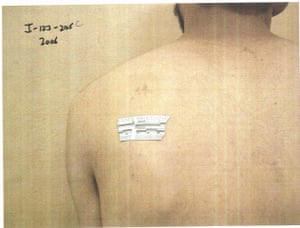
Several photos were grainy, showing sections of
the body where detainees alleged US troops harmed them, without showing a
person in full. Several images displayed detainees’ legs, backs, feet
and occasionally their heads, though the head photographs did not show
visible contusions.
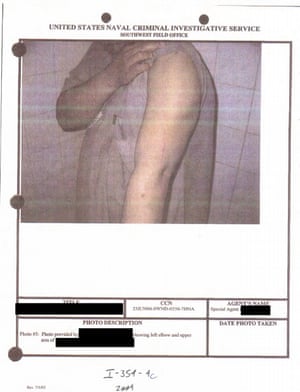
Image depicts detainee’s arm injury. No further context was provided. Photograph: Department of Defense None of the photographs showed a detained man’s unobscured face.
A
Pentagon statement accompanying the photos said that the investigations
they supported had resulted in 14 substantiated allegations, from which
“65 service members received some form of disciplinary action”, ranging
from letters of reprimand to life imprisonment.
While a full
accounting of what the photos show remains elusive, the ACLU believes
that among the still-suppressed photos are imagery of a female soldier
sexually abusing a detainee with a broomstick; an Iraqi civilian farmer
executed by US troops while his hands were tied behind his back; and
autopsy photos of an Afghan detainee known as Dilawar, whose death was
the subject of Alex Gibney’s acclaimed 2007 documentary Taxi to the Dark
Side.
Since the ACLU first sought the photos in the wake of
the international outcry over US torture at Iraq’s Abu Ghraib prison, a
wall of US government resistance had long held firm. Famously, in May
2009, Obama reversed his position on the photograph’s release in May
2009, and ordered the photos to remain hidden, contending they would “further inflame anti-American opinion” if released.
Later
that year, Congress passed the Protected National Security Documents
Act, to suppress any Bush-era photographs of detainees in military
custody unless the defense secretary could vouch that their release
would have minimal consequences for US troops.
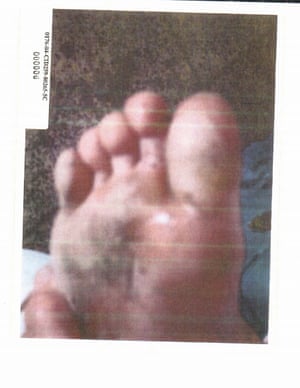
Image depicts detainee’s foot injury. No further context was provided. Photograph: Department of Defense But the ACLU won a breakthrough in 2014 after a decade of litigation. A federal judge in New York, Alvin Hellerstein, rejected
the government’s desired blanket ban on the photos in 2014 and required
the Pentagon to individually certify images it considered harmful to
national security and explain its reasoning.
After viewing some of
the photographs privately, Hellerstein said in August 2014 that some of
them were “relatively innocuous while others need more serious
consideration”.
Hellerstein’s assessment contradicted two defense
secretaries, Robert Gates and Leon Panetta, as well as US marine
generals James Mattis and John Allen, all of whom certified that the
wholesale release of the detainee photo trove would “endanger citizens
of the United States, members of the United States armed forces, or
employees of the United States Government deployed outside the United
States”.
A Pentagon statement said that senior military commanders
were consulted before the release, and pledged the military to ensuring
“the safe, lawful, and humane treatment of individuals in U.S. custody
in the context of armed conflicts, consistent with the treaty
obligations of the United States, including the Geneva Conventions”.
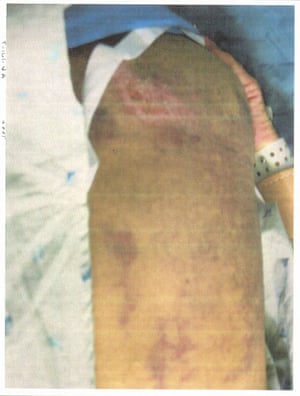
Image depicts what appears to be a detainee’s leg injury. No further context was provided. Photograph: Department of Defense Still,
the ACLU vowed to continue its fight for the release of all the
photographs. The next hearing in the group’s ongoing transparency
lawsuit is due for 19 February, before Hellerstein.
The ACLU’s Abdo cited the case of Eric Garner, whose choking death by New York police
was filmed and distributed on social media, as a testament to the
unique power of imagery to galvanize change and drive calls for justice.
“We
think the photos, when released, have the ability to do the same for
accountability for the abuse of detainees, and I think the Pentagon
knows it, too,” Abdo said.


No comments:
Post a Comment