Brian
Nelson spent 12 years of his life staring at four concrete walls. “Day
after day, all I saw was gray walls,” he writes of his time in solitary
confinement at Tamms Correctional Center in Illinois, “and over time my
world became the gray box.” While in solitary, Nelson lost 41 pounds,
developed severe psychological problems and prayed for death to end his
suffering.
Nelson,
who was convicted of robbery and murder at the age of 17, understands
that crimes bring consequences. But solitary confinement, he says, is
more than punishment—it is torture. It is designed to deny human
fellowship and strip away human dignity. A devout Catholic, Nelson
describes solitary confinement as “just plain cruel and completely
against the Catholic Church.” He explains: “In solitary, you have no
creation. You have some air, some water and maybe a bug or two. That’s
it.”
Prisoners
in solitary confinement spend 22 to 24 hours a day in an 8-foot by
10-foot cell in conditions of extreme isolation and sensory deprivation.
Some, like Nelson, languish in these tomb-like cells for years or even
decades. And in the United States, the practice is far from rare.
Although solitary confinement is often thought of as a last resort for
the most dangerous criminals, in fact 80,000 prisoners are held in
isolation in state and federal prisons across the country on any given
day. Many are placed in solitary confinement for nonviolent infractions
like possession of contraband or failure to obey an order promptly.
During
his years in isolation, Nelson suffered extreme insomnia, was unable to
eat, developed blood blisters from his uncontrollable pacing and grew
so depressed that at times he lost the will to live. “Every day…I got
down on my knees and prayed that I would die in my sleep,” he writes,
“yet God’s will was not mine.”
Nelson
did what he could to keep sane. “I fought hard with my own mind, and I
prayed,” he says. He copied the entire Bible by hand, read hundreds of
books on Catholicism and followed the Trappist tradition of praying
seven times a day. But it was a struggle to maintain his religious
practice amid the isolation. “As Catholics, we should participate in the
communion of saints with each other. We are not supposed to be alone.”
Nelson
also faced frequent denials of his religious rights. He was unable to
attend Mass and was often denied the chance to receive Communion. He was
harassed and placed on suicide watch for fasting or abstaining from
meat and sometimes was even denied his Bible, prayer book and rosary. “I
did confession at my cell front,” he says. “An officer could hear it.
There was a speaker in my cell. They wouldn’t give me privacy. But my
soul is more important.”
The
past decade has witnessed an increase in resistance to solitary
confinement by human rights and civil liberties groups, mental health
advocates, concerned citizens and people of faith, including Catholics.
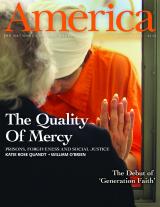 The title of this piece is the title of a cover story in the latest issue of America: The National Catholic Review, written by Solitary Watch Reporter/Researcher Katie Rose Quandt. An excerpt follows; you can read the full piece on the America website.


No comments:
Post a Comment