Voices from Solitary: Analyzing Isolation, Part I
by Voices from Solitary
This post is the next in a series of pieces
Solitary Watch is publishing as part of a project calling for people
held in solitary confinement to write on various proposed themes. Our
second suggested theme, "Analyzing Isolation," calls for writers to
provide their analyses of solitary, discussing ways in which the
practice is counterproductive.
The
following comes from Robert W. Howe, who was serving his fourth year at
federal supermax ADX Florence in rural Colorado at the time this piece
was written. According to his letter, he will have spent almost a
decade at the federal supermax upon his release to a lower security prison (so long as he receives no write-ups for rule violations). In his piece, entitled "Thoughts from Inside the Control Unit: A Prisoner's Perspective," Howe describes the effects of "being physically confined in an extremely small cell for years on end." –Lisa Dawson
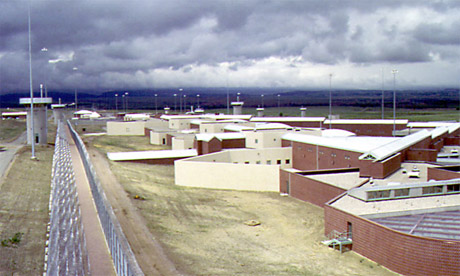
Credits: The Guardian
≡≡≡≡≡
Truth About Consequences
The
control unit at U.S. penitentiary max in Florence, Colorado, is a
23-hour a day lockdown facility, where I am currently serving a 95-month
administrative sentence. I was given this sentence for taking a
correctional officer hostage for two and half hours at USP Atwater in
October 2007. I was given an additional life sentence for the hostage
incident. The administrative 95-month sentence is the FBOP’s way to seek
some form of retribution for my actions. Now the BOP will say that I'm
not being punished. By the end of this essay I would like for you, the
reader, to determine where the truth lies. There's three sides to every
story: their side, my side and then there's the truth...
Into
my fourth year here at the federal supermax control unit, certain
issues are becoming readily apparent. Psychological strains of anxiety
and bouts of mild depression are beginning to surface in this stark
encapsulated environment. I find myself constantly rearranging the small
amount of property I’m allowed to keep. I do this in order to break up
the samenesss of my cell and the “Groundhog Day” effect of repetitious
occurrence.
The
ever-present background noise of demented individuals who bang,
broadcasting toothless – or tooth-full – threats, the sounds of the
toilets, sinks, showers, sliding grill-gate bars, steel doors, fire
alarms blaring, officers keys clanking, staff radio blare at full
volume, and a myriad of other sounds that become nuisance noise
constantly assault your senses.
The
consequences of being physically confined in an extremely small cell
for years on end have already begun to take a toll. Since my arrival
here, I have suffered prolonged hypertension, necessitating blood
pressure medication and chronic care visits. The optometrist gave me
glasses and told me that individuals who are confined lose their vision
at a higher rate due to the fact that we don’t get to use our long
distance vision. I have joint pain from the never-ending hard surfaces,
vitamin deficiency from lack of natural sunlight and probably others
that would take a professional to diagnose.
Stark or Stark Raving
While
it is true that one doesn’t need to worry about being in a physical
altercation in the control unit (except with staff), the assault on your
physical being and mental state is constant and unrelenting. When this
facility opened, it was labeled as “one of the most psychologically
debilitating places on earth” (Newsweek, July 13, 1998).
I
have been amazed at the physical conditions. The parts that I have been
subjected to are antiseptically stark. When I arrived here, I was
placed on A-Range in the Special Housing Unit (SHU), which always
smelled of mace, feces, urine and the musk of unwashed bodies. That is
where dysfunctional inmates who have severe mental and/or disciplinary
issues were kept. The control unit has its own version of A-Range,
albeit scaled down to a few glass houses, which are cells with Plexiglas
on the bars. Even here in the control unit, where rigid protocols are
claimed to be enforced, inmates with psychological issues are supposed
to be screened out. Yet I find it fascinating that I continue to observe
individuals who have degenerated into babbling, banging, crying and
erratic behaviors, including successful suicide.
The
jaded attitudes of staff and inmates alike seem to incubate a culture
of pervasiveness and apathy. My observations these past few years have
detected unconcern, psychological degradation and outright alienation of
the mentally ill. The psychology department’s attitude towards control
unit inmates is dismissive at best and unscrupulous at worst…
Control’s Silent Tool
Most
control unit inmates were at one point social creatures similar to
regular individuals with the exception that they’ve been forced to
inhabit an unnaturally sterile microcosm in an environment that
restricts social means not just with other inmates, but also with family
and friends. When the administration only allows someone one 15-minute
phone call per month, and restricts the amount of mail they can send out
by providing stamped, addressed envelopes under the guise of a
“security issue,” instead of selling them on commissary, that is an
administrative penal effort to staunch social interaction. When you go
to team hearings, they request that you have good familial ties, and if
you don’t, points can be added to you security score, which of course
they control. The average inmate in the bureau supposedly gets 300
minutes each month of phone time and “unlimited” mailing privileges.
It’s almost Kafkaesque, the treatment disparity we incur. Even Senator
John McCain said of extended solitary confinement, “It's an awful thing,
solitary… It crushes your spirit and weakens your resistance more
effectively than any other form of torture or mistreatment."
…If
I am able to remain incident free, I will not be eligible to leave ADX
until I have almost a decade ensconced in this environment. What amount
of resilience am I going to need to stay sane, much less remain socially
acceptable to my peers? I feel like Sisyphus, forever sentenced to roll
my boulder up the hill, only to find myself at the bottom with no end
in sight.
Unspirited Letter of Law
Control
unit confinement is a beast unto itself. Federal courts have given
prison administrators carte-blanche to run their operations with little
to no oversight. With the emphasis here on “control,” control implies
being controlled by someone or something. The question begs then, with
the body controlled, what price does the mind suffer? The influence of
physical control on the body has serious significance on one’s mental
state. There is no human being that can tell me this environment is
conducive to even fair mental health; even those who work and study this
environment lead compartmentalized lives.


No comments:
Post a Comment