The Gay Courier has been established to provide news, information and info on, from and about the gay community, and other social events and happenings from around the world, from all sorts of sources, to all who are interested in this news, information and info!
The postings are as is, and all copyrights and or ownerships are and remain with the original copyright-holder and or owner!
Search This Blog
Tuesday, March 3, 2015
Afghanistan officials sanctioned murder, torture and rape
Human Rights Watch accuses high-ranking officials of allowing
extrajudicial killings and brutal practices to flourish after fall of
Taliban
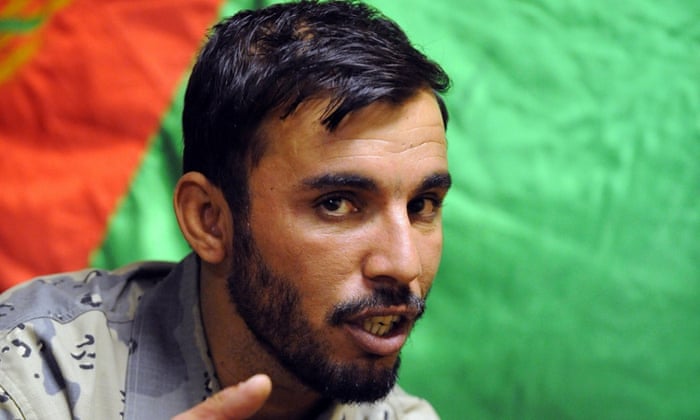
Kandahar’s police chief Abdul Razziq was praised by Kabul and Washington
despite claims of extrajudicial killings, according to the Human Rights
Watch report. Photograph: Romeo Gacad/AFP/Getty Images
Top Afghan officials have presided over murders, abduction, and other
abuses with the tacit backing of their government and its western
allies, Human Rights Watch says in a new report.
A grim account of deaths, robbery, rapes and extrajudicial killings, Today We Shall All Die,
details a culture of impunity that the rights group says flourished
after the fall of the Taliban, driven by the desire for immediate
control of security at almost any price.
“The rise of abusive political and criminal networks was not
inevitable,” the report said. “Short-term concerns for maintaining a
bulwark against the Taliban have undermined aspirations for long-term
good governance and respect for human rights in Afghanistan.”
The report focuses on eight commanders and officials across
Afghanistan, some of them counted among the country’s most powerful men,
and key allies for foreign troops. Some are accused of personally
inflicting violence, others of having responsibility for militias or
government forces that committed the crimes.
Kandahar’s most powerful commander, the former head of the
intelligence service and a key northern governor are among those
implicated. All of the accused have denied the allegations against them.
Some have ties to the former president Hamid Karzai,
who as early as 2002 warned that security would be his first priority.
“Justice [is] a luxury for now; we must not lose peace for that,” the
report quotes him saying soon after coming to power. While he was in
office, a blanket amnesty law for civil war-era crimes was passed.
Advertisement
There
are also multiple links to America’s military and government, sometimes
beyond the liaisons that were essential for troops on the ground.
When Assadullah Khalid, the former head of the country’s spy agency, was badly injured in a Taliban
assassination attempt, Barack Obama and the former defence secretary
Leon Panetta both went to visit him in the American hospital where he
was recovering.
In doing so they chose to ignore a long history of accusations of
rape, torture, corruption and illegal detentions, some of it from US
diplomats or their allies, detailed in the HRW report.
A confidential Canadian government report from 2007 warned that
“allegations of human rights abuses by [Khalid] are numerous and
consistent” and he was described as “exceptionally corrupt and
incompetent” in a leaked US embassy cable.
Khalid has previously dismissed the allegations against him as
fabrications. “I know there is nothing (in terms of evidence),” he said
in 2012, when his nomination as spy chief stirred up controversy about
his past. “This is just propaganda about me.”
Another favourite of US forces, Kandahar’s police chief Abdul Razziq, was pictured last year arm in arm with a beaming three-star US general, who credited him with improving security in the political and cultural heart of southern Afghanistan.
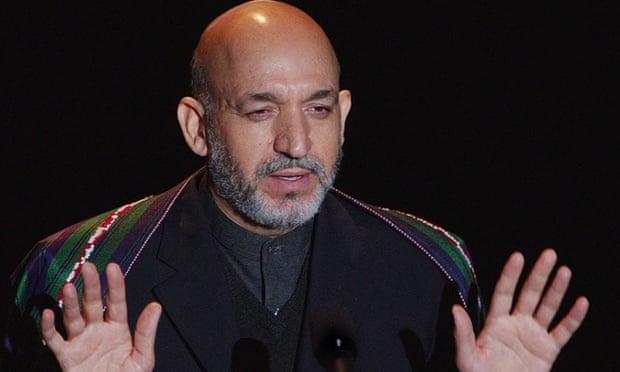
Hamid Karzai accepts the Freedom
award from the International Rescue Committee in New York, 2002. The
president said he would make security his first priority after he came
to power.Photograph: Mark Lennihan/AP
Yet his rise to power he has been dogged by a trail of allegations of
extrajudicial killings, forced disappearances and torture, some
described by HRW in gruesome detail. As early as 2006, when still
leading a unit of border police, he was accused of the abduction and
murder of 16 men, said to be in a revenge killing for the death of his
brother.
“The acting commander of border police in Kandahar, Abdul Razzaq
Achakzai [Raziq], has acknowledged killing the victims, but has claimed
(claims now proved false) that the killings took place during an ambush
he conducted against Taliban infiltrators,” a report by the office of
the EU envoy to Afghanistan said then.
Since he took control of the province’s police in 2011, the United Nations has documented
“systematic” use of torture in Kandahar’s police and intelligence
units, and the Human Rights Watch report lists multiple cases of men
detained by Kandahar police, whose mutilated corpses were found
discarded days later. Raziq has repeatedly denied all allegations of
wrongdoing.
Raziq has categorically denied all charges of abuse, as attempts to
undermine him. “When someone works well, then he finds a lot of enemies
who try to ruin his name,” he told the Atlanticin 2011.
Last year he told the New York Times: “I don’t think people fear me...at least I don’t want them to fear me.”
The report also details large-scale corruption, that is said to have
eroded both security and confidence in the government, while stuffing
the coffers of abusive strongmen. Lucrative contracts for logistics and
security allowed some to maintain militias under official cover, and pay
off the Taliban instead of trying to defeat them, HRW said, while other
security officials were involved in drug production and trafficking.
Afghanistan is one of the most corrupt countries in the world,
according to Transparency International, and the compromised justice
system also badly undermines accountability, with little sense among
ordinary Afghans that abusers will ever be held to account.
“Initiatives ostensibly undertaken to curb corruption and other
abuses have had virtually no impact, for the same reasons there has been
no progress tackling impunity in other areas,” the report said.
“Officially, the United States has backed anti-corruption measures,
while at the same time reportedly protecting officials accused of
corruption who have been deemed vital to the war effort.”
Atta Mohammad Noor, the influential governor of northern Balkh
province is one of those the report says profited from Nato projects to
expand the security forces, using them to absorb and fund his own
militias, hundreds of men strong. They have been accused of abuses for
which HRW says Atta bears responsibility, even if he is not head of a
formal chain of command. Atta denies the allegations in the report.
“The informal nature of militias can make it difficult to establish
who has ultimate command responsibility for their actions,” the report
says. “However, the available evidence indicates that they could not
operate without Atta’s consent and have been effectively under his
control, including at the time of the alleged abuses.”
It quotes him telling one villager who complained about killings by a
militia group under his command in 2011. “Please forgive [the killer],
it was just a mistake.”
Atta in 2011 said that two of the militias he ran were needed to
secure his province because Karzai’s government refused to increase
police and army ranks there. “The people who complain about militia are
people who have links with the Taliban,” he told the Wall Street Journal.
Human Rights Watch called on the Afghan government and its
international backers to do more to hold the security forces to account.
Despite meticulous documentation of many cases of abuse, there has not
been a single prosecution for torture.
Afghanistan’s new president, Ashraf Ghani, said his government would
not tolerate torture and thanked HRW for the report, but did not respond
to the individual allegations.


No comments:
Post a Comment