Arctic blast to drop temperatures in U.S. to lows not seen in years
January 4, 2014 -- Updated 1135 GMT (1935 HKT)
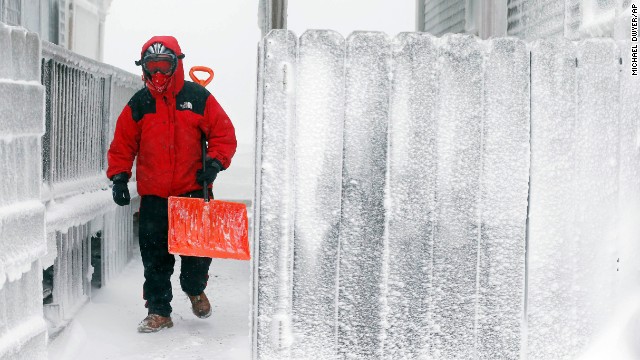 Michael Stanton walks between houses covered with ice in the shore town of Scituate, Massachusetts, on Friday, January 3.
HIDE CAPTION
Wintry weather strikes Midwest, Northeast
STORY HIGHLIGHTS
- NEW: Man dies Friday of hypothermia in Wisconsin
- Nearly half of all Americans will feel zero or below temperatures by Wednesday
- Nights in North Dakota will be nearly -30 degrees Fahrenheit cold
- Wind chills will drop to minus 50 in some places; frost bite can strike quickly
Get ready for bone-chilling cold you haven't endured in years, the National Weather Service said.
Nearly half the nation -- 140 million people -- will shiver under zero degrees Fahrenheit or lower by Wednesday.
An arctic blast that drove the mercury to near minus 40 in parts of Canada is roaring into the United States.
It is threatening to sweep subzero lows as far south as Alabama, and plunge much of the Deep South into the teens.
Opening act
The blast burst onto
stage in the northern Plains States early Saturday, pushing out previous
highs in the 40s and 50s. It hurled North Dakota into minus territory,
as the weather service predicted a day-long blizzard for the state.
Parts of Montana and Minnesota were feeling the same pain, the NWS said.
If there was ever a
winter-toughened state, it's Minnesota, but with this frosty bite on its
way, schools in the state are shutting their doors on Monday.
"I have made this decision to protect all our children from the dangerously cold temperatures," Minnesota Gov. Mark Dayton said.
Saturday's temperatures
will look spring-like a day later, as the thermometer falls to near -30
in parts of North Dakota. And the wind will drive chills down to -50
degrees, the weather service said.
That's a recipe for rapid frost bite or hypothermia.
A man age 66 died Friday of hypothermia in Milwaukee, Wisconsin, on Friday, the medical examiner's office said.
The weather service's
Twin Cities, Minnesota, division warns, "Exposed flesh can freeze in as
little as five minutes with wind chills colder than 50 below."
This system will produce "the coldest air in two decades," the service said.
The danger of injury and death from the cold will spread with the cold front into the Midwest by Monday night.
Upper Midwest
Sunday night in Chicago
will see a shivering minus 16 to 20 below and -- once you factor in the
Windy City's stiff breeze -- a chill of 35 below to 45 below zero.
Lambeau Field in Green
Bay, Wisconsin, is unfortunately not a domed stadium. Fans and players
there will sit outdoors and brave temperatures approaching minus 20, as
the Packers battle the San Francisco 49ers for a chance to advance to
the Super Bowl.
Some sports writers speculated that it may go down as the coldest football game ever played.
The Packers organization
and a stadium vending company will serve free hot chocolate and coffee
to help fans withstand the deep freeze, as wind chills dip to 50 below.
As Packers head coach Mike McCarthy said Friday: "This is not the norm."
Marching on
As the arctic cold
conquers about half of the continental United States, temperatures are
forecast to dip into the minus teens through the lower Midwest. Snow
will cover swaths from the plains to the Ohio and Mississippi River
valleys all the way to New England.
Parts of the Midwest could see temperatures not recorded in 15 to 20 years -- for a painful couple of days.
Even areas as far south
as Nashville, Tennessee, could be frozen solid in zero-degree cold as
the arctic air mass dives southward at the beginning of next week.
Flight madness
Thousands were stuck at
airports nationwide Friday because of system-wide delays -- though at
least they not out in the frigid cold.
FlightAware.com, which
tracks cancellations due to weather and mechanical problems, said about
3,200 flights were canceled Friday within, into or out of the United
States.
Expect more of the same in the coming days. Long before sunup Saturday, over 500 flights were struck with half as many delayed.
Though the temperature
in Las Vegas was 52 degrees -- above zero -- passengers there were also
feeling the winter's sting Friday.
Long lines formed inside
McCarran International Airport at the counters for Southwest Airlines,
which had canceled many of its flights to and from Chicago. The airline
carries 40% of Las Vegas' passengers, according to Chris Hayes, an
airport spokesman.
Insane snow that was
It's not like those who braved the last storm would have it easy, even if more snow was not on the way.
Just ask Ford Fischer.
The CNN iReporter spent part of Friday trying to clear the driveway
around his home in Boxford, Massachusetts, where the weather service
said more snow -- 23.8 inches -- fell than in any other community hit by
the Thursday-into-Friday nor'easter.
Every time he finished a spot, he'd turn around and see it covered with snow again.
"The snow was absolutely insane," Fischer said, "and totally nonstop."
Even after the snow was done, the bottom dropped out of the temperature.
In parts of New York
City, where as much as 8 inches of snow fell, the mercury dropped to
near zero Friday night for the first time since January 1994.
It was also set to dip below zero, with minus 17 wind chill, in Boston after nearly 18 inches of snow.
Outages not as widespread
Power outages were not
as widespread despite blizzard-level winds in some places when the
nor'easter passed through in previous days.
Three people died in car accidents in Pennsylvania -- including one man crushed as he was moving street salt with a forklift.
A car accident in icy conditions in Indiana killed one person Tuesday, authorities said.
In Byron, New York, a 71-year-old woman was found dead in the cold weather, authorities said.
And in Torrington, Connecticut, a man died in a weather-related car accident Friday.


No comments:
Post a Comment